

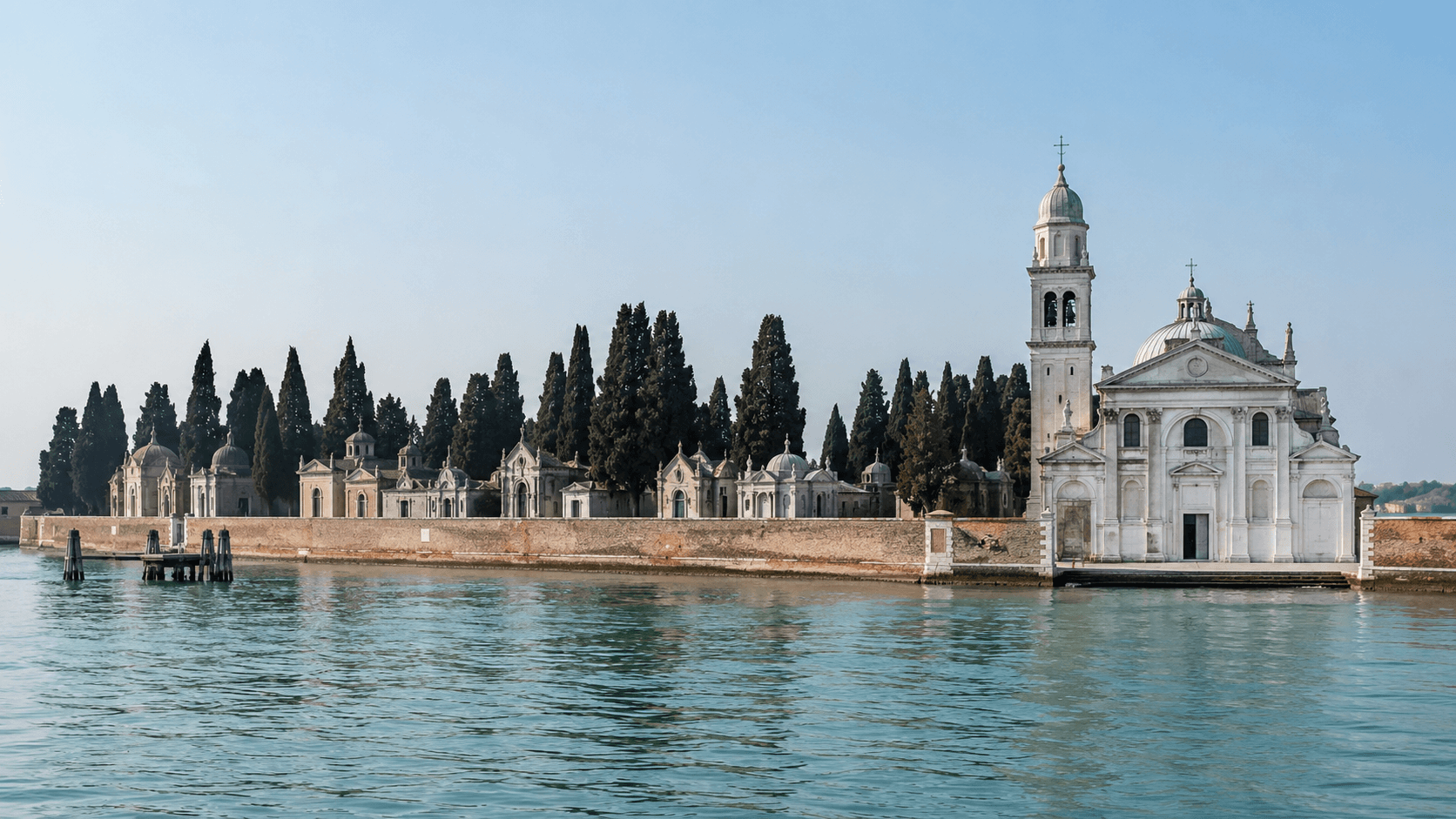
Location and How to Get to San Michele Island
San Michele Island is located in the northern lagoon, halfway between the Cannaregio district (sestiere) and the island of Murano. It cannot be reached on foot: the only way to visit is via ACTV water bus (vaporetto), which stops right in front of the cemetery’s monumental entrance.
- Stop: “Cimitero”, served by lines 4.1 and 4.2 (also 12 and 13 during specific times)
- Most Convenient Boarding Point: Fondamente Nove, just a short boat ride away
- Travel Time from Fondamente Nove: Approx. 3–5 minutes
- Cemetery Admission: Free
- Opening Hours: 7:30 AM–6:00 PM during summer, 7:30 AM–4:30 PM during winter (early closing at 12:00 PM on January 1st, Easter, and Christmas)
Venice: ACTV Daily Vaporetto Pass
A History Spanning Over a Thousand Years
Long before becoming the cemetery of Venice, San Michele was a vibrant site of religious and civic life. Since the 10th century, the island hosted a church dedicated to Archangel Michael and served as a shelter for the boats of Murano glassmakers, earning it the name “Cavana de Muran.” During the 13th century, Camaldolese monks settled here, turning it into a center for study, prayer, and cartography. It was right here in the 15th century that the monk Fra Mauro created his famous 1450 World Map, one of the most important cartographic works of European Medieval history.
With the fall of the Republic and the Napoleonic suppressions, the monastery lost its religious function and briefly served as a political prison, housing figures like Silvio Pellico and Pietro Maroncelli. The decisive turning point came in 1804 when Napoleon Bonaparte’s Edict of Saint-Cloud prohibited burials within city walls for hygienic reasons. In 1807, Napoleon chose the neighboring island of San Cristoforo della Pace as the site for the new city cemetery, entrusting the project to architect Giannantonio Selva—the same architect behind the La Fenice Theatre.
Between 1829 and 1837, the canal separating San Cristoforo from San Michele was gradually filled in, merging the two islands into a single body. Thus, the cemetery was born that still welcomes Venetians and the many foreigners who chose the city as their final resting place today.
The Church of San Michele in Isola: The Debut of the Renaissance in Venice
Greeting visitors as they disembark on the island is the pristine white facade of the Church of San Michele in Isola, built between 1469 and 1479 to a design by architect Mauro Codussi. It is considered the very first fully Renaissance church in Venice—the point at which the lagoon city abandoned Gothic lines to embrace the classical balance learned in Florence and Rome.
The facade, clad entirely in bright white Istrian stone, is striking for its geometric purity: curved volumes, harmonious proportions, and a semicircular crown that anticipated design solutions destined to become models for other Venetian churches, such as the Madonna dei Miracoli in Motta di Livenza. The interior, simple and bright, still preserves the contemplative atmosphere of the Camaldolese monastery, while the adjacent cloister and the 16th-century Emiliani Chapel—with its octagonal layout—offer one of the most elegant and least frequented spots in the entire lagoon.
The Cemetery: Sectors, Cloisters, and Venice’s Cosmopolitan Soul
Beyond the church, the cemetery opens up into a sequence of tree-lined avenues, silent cloisters, and monumental enclosures. The layout reflects the city’s multiconfessional history. Alongside the vast Catholic sector—where elaborate 19th-century tombs are lined with weeping angels, medallions, and sculpted drapery detailing the wealth of Venetian bourgeois and noble families—you will find the Evangelical enclosure, reserved for the Protestant community, and the Greek Orthodox section, testifying to the many foreigners who adopted Venice as their homeland. A separate area is dedicated to military burials.
The city’s only historical cemetery not included on the island is the Jewish Cemetery, which is located on the Lido of Venice, along Riviera San Nicolò.
As is common on lagoon islands, space has always been an issue. After a burial period of roughly ten years, many graves are exhumed and the remains transferred to an ossuary. To address this need, an international competition in 1998 awarded British architect David Chipperfield the project to expand the island. Completed in 2017, the expansion introduced new internal courtyards, an ossuary, and a service building—a contemporary intervention that respectfully dialogues with Codussi’s Renaissance architecture.
Tombs Through History
Strolling along the paths of San Michele means stumbling—often without looking for them—upon the graves of major 20th-century figures. In the Greek Orthodox sector rest composer Igor Stravinsky, beside his wife Vera, and Sergei Diaghilev, the famed founder of the Ballets Russes; Diaghilev’s gravestone is almost always covered in ballet shoes left as tributes by dancers from around the world.
In the nearby Evangelical section lies the tomb of poet and Nobel laureate Joseph Brodsky, who wrote memorable pages about Venice. A few steps away rests another literary icon, Ezra Pound, buried alongside his partner Olga Rudge in a simple garden plot almost hidden among the greenery.
The island also holds the graves of composer Luigi Nono, painter Emilio Vedova, psychiatrist Franco Basaglia, Austrian physicist Christian Doppler, and football manager Helenio Herrera—proof of how deeply Venice attracted artists, scientists, and intellectuals from across Europe over the centuries.
Practical Tips for Organizing Your Visit
San Michele is an active cemetery, not a tourist attraction in the strict sense; it warrants a quiet, respectful visit with hushed voices and a unhurried pace. Here are a few tips to make the most of it:
- Visit on a weekday, preferably in the morning, to experience the island almost deserted.
- A map is available at the entrance marking the Evangelical and Greek Orthodox sectors, where the most visited tombs are located.
- Allow 45–60 minutes for a relaxed visit to the church, cloisters, and cemetery.
- Bring water and a hat during summer months: there are no cafes or widespread shaded areas on the island.
- If you plan to travel frequently across the lagoon during your trip, a multi-day transit pass or city card will save you from buying individual water bus tickets for every ride.
Venice City Pass all Inclusive 72h
Combining Your Visit with Murano and Burano
Lines 4.1 and 4.2, which stop at San Michele, continue onward to Murano—famous for its blown glass furnaces—and allow you to reach Burano, the island of colorful houses and lace-making, on a single transit pass. Many visitors choose to spend the morning taking in the monumental cemetery and its peace, continuing in the afternoon to the livelier islands of the northern lagoon.

Ticket for Museums of the Venetian Islands: Murano and Burano
FAQ – Frequently Asked Questions About San Michele Island
1. Is admission to San Michele Cemetery free? Yes, access to the cemetery and the Church of San Michele in Isola is free of charge, just like all municipal cemeteries in Venice. The only cost to consider is the water bus ticket to reach the island.
2. How do you get to San Michele Island from Venice? It is reached exclusively by water bus (vaporetto), using ACTV lines 4.1 and 4.2 and getting off at the “Cimitero” stop. The most convenient boarding point is Fondamente Nove, where the crossing takes just a few minutes.
3. How much time is needed to visit San Michele Cemetery? A leisurely visit to Codussi’s church, the cloister, and the main cemetery sectors takes about 45–60 minutes. Those wishing to locate notable graves more carefully should plan for up to 90 minutes.
4. Where are the tombs of Stravinsky and Diaghilev located? Igor Stravinsky rests in the Greek Orthodox sector, not far from the tomb of Sergei Diaghilev, which is often covered with ballet shoes left by visitors. In the nearby Evangelical enclosure, you will find the tombs of Ezra Pound and Joseph Brodsky.
5. Is it possible to visit the Church of San Michele in Isola? Yes, the church is generally open to visitors during the cemetery’s opening hours. It is the earliest example of Renaissance architecture in Venice, designed by Mauro Codussi between 1469 and 1479, and is well worth a stop if only to admire its Istrian stone facade.
6. Can you combine a visit to San Michele with Murano and Burano? Yes. The same water bus lines that stop at San Michele continue to Murano and allow you, with a transfer, to reach Burano as well—making it an ideal itinerary for anyone looking to spend half a day exploring the northern lagoon islands.
You Might Also Like