

Venice in high season: how to manage the trip between crowds and costs
- 8 min read
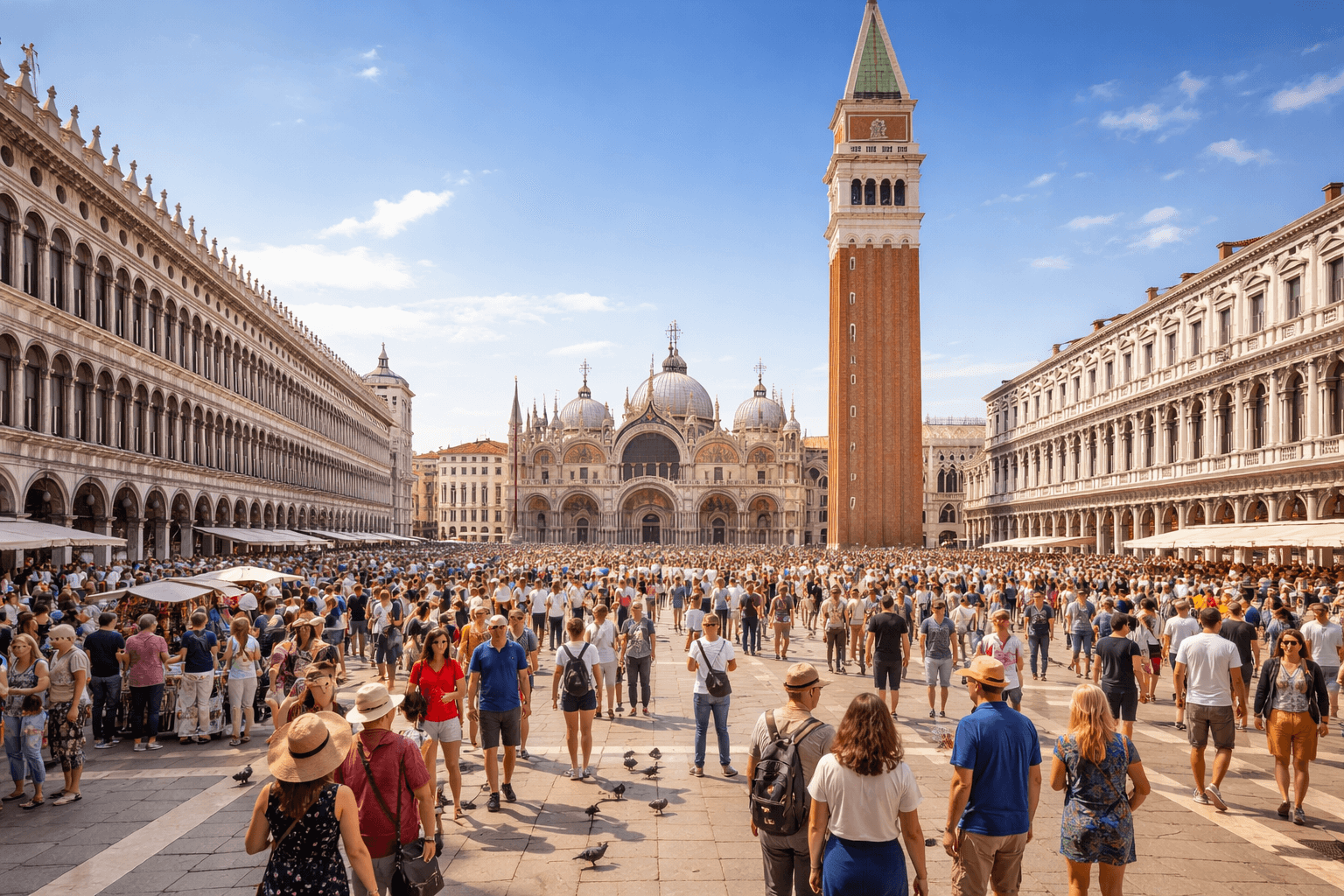
Visiting Venice in high season is often considered a mistake, due to the high tourist presence and higher costs. However, this conviction stems from an incomplete experience of the city. In reality, Venice is never the same and changes profoundly based on how it is lived. This is because high season is not just crowds, but also light, events, vitality, and atmospheres that are difficult to find at other times of the year. Because high season is not just overcrowding, but also light, vitality, cultural openness, and possibility. Due to a simplified narrative, these aspects are often sidelined. In summary, Venice in high season is not a destination to avoid, but an experience to be understood and managed with a method.
Venice City Pass all Inclusive 72h
What is really meant by Venice in high season
When the expression Venice in high season is used, it often refers to a rather broad timeframe ranging from spring to early autumn. However, this generic definition does not take into account the profound differences that exist between one period and another. Due to events, holidays, weekends, and long weekends, tourist intensity can vary significantly even within the same month. Generally, the high season includes the months from April to September, with evident peaks between May, June, and August. Because it is not just a numerical issue. High season also coincides with the moment when Venice is most easily accessible, most photographed, and most talked about, becoming a sort of permanent stage. In summary, Venice in high season represents the period of maximum exposure for the city, in which extraordinary beauty and constant pressure coexist.
Why Venice in high season is often misunderstood
The misunderstanding arises mainly from the first impact. Due to the concentrated influx in the most iconic areas, many visitors quickly develop a negative perception of the city. However, this perception is strongly influenced by the route followed, the times chosen, and the initial expectations. Because Venice does not function like other tourist cities. It does not have grand avenues, it does not distribute flows uniformly, and it does not offer an immediate reading of its spaces. In summary, Venice in high season is often judged based on a few square kilometers, ignoring the complexity and variety that continue to exist even in the most crowded periods.
When high season coincides with maximum splendor
Despite the criticalities, Venice in high season also coincides with the period in which the city offers the most from a visual and cultural point of view. Due to the longer days, Venice can be experienced with greater continuity, without the time compression typical of the winter months. Because light plays a central role. The reflections on the water, the facades illuminated for hours, and the prolonged sunsets contribute to creating an intense visual experience. Furthermore, high season is the period in which museums, exhibition spaces, and cultural events reach their maximum level of activity. In summary, the most crowded moment is also the richest in opportunities, if approached with awareness.
The real problems of high season in Venice
Overcrowding and tourist flows Overcrowding represents one of the most evident aspects of Venice in high season, however, it is not distributed uniformly. Due to the presence of symbolic attractions and mandatory routes, tourist flows always concentrate on the same axes, creating very evident saturation points. Because Venice is a stratified city, built on a dense network of secondary paths. Moving even slightly away from the main thoroughfares allows one to perceive a completely different reality. In summary, the problem is not so much the number of visitors as their spatial and temporal concentration.
High prices and limited availability During Venice in high season, the increase in prices is a direct consequence of high demand. However, this phenomenon does not affect all experiences in the same way. Due to a lack of planning, many visitors end up choosing immediate and therefore more expensive solutions. Because sustainable alternatives exist, which only require more attention and foresight. In summary, high costs are often the result of rushed choices rather than a real scarcity of options.
Venice City Pass all Inclusive 72h
How to face Venice in high season with the right mindset
Facing Venice in high season means first of all reviewing one’s expectations. Because one of the most common mistakes is wanting to concentrate too many experiences in a short time. Due to this setup, the visit loses depth and becomes a continuous race. In summary, Venice does not reward speed, but attention. Agreeing to give something up, slowing down, and observing the details allows for the construction of a more authentic and less stressful experience.
Strategic hours: when to visit Venice to avoid the crowd
One of the most underrated aspects in planning Venice in high season is the choice of hours. Because most visitors tend to move during the same slots of the day, creating very predictable peaks of overcrowding. Due to this dynamic, anticipating or postponing visits allows one to experience a completely different city. In summary, Venice changes its face depending on the time, and knowing how to exploit this is one of the most effective tools for reducing stress.
Central zones and alternative zones: how to choose where to go
During high season, central areas are inevitably more congested. However, Venice is not composed only of its symbolic places. Due to the presence of neighborhoods with a strong residential vocation, there are areas that maintain a more authentic dimension even in the most intense months. In summary, choosing alternative zones does not mean giving up the Venetian experience, but expanding it and making it more balanced.
How to get around Venice on a budget
Getting around Venice is often perceived as expensive, however, due to the compact structure of the city, much of the movement can be done on foot. Public transport is useful, but if used without criteria, it significantly impacts the budget. In summary, planning movements and prioritizing walking allows not only for saving money but also for understanding the city better.
Where to sleep during high season without spending too much
Finding accommodation during Venice in high season is one of the main criticalities for tourists. However, this often depends on research limited to the most requested areas. Due to high demand, central structures quickly reach high prices. In summary, broadening the search area and booking well in advance allows for finding more economically balanced solutions.
Eating well in Venice even in the busiest months
Eating well in Venice is possible even in high season, however, it requires attention and a spirit of observation. Due to the presence of numerous venues oriented exclusively towards tourists, many visitors have disappointing gastronomic experiences. Because it is enough to move away from the main routes to find more authentic dining. In summary, the quality of food improves proportionally to the distance from the most crowded areas.
Authentic experiences possible even in high season
Even during Venice in high season, authentic experiences exist. Because authenticity does not depend on the absence of tourists, but on the ability to live the city in a conscious way. In summary, simple moments such as an evening walk, a stop in a quiet square (campo), or a ferry ride can restore a deeper perception of the city.
Mistakes to absolutely avoid in Venice in high season
The most common mistakes during Venice in high season derive from a poorly conscious approach. Due to improvisation, many visitors end up automatically following the crowd, replicating the same routes and experiencing the same criticalities. Because Venice does not work by accumulation, but by selection. In summary, avoiding overloading the days, underestimating distances, and ignoring schedules means compromising the entire experience.
Venice City Pass all Inclusive 72h
FAQ – Frequently Asked Questions about Venice in high season
-
When is high season in Venice?
From spring to early autumn, including major holidays and events.
-
What is the cheapest period to go to Venice?
The winter months, excluding Carnival.
-
When to avoid Venice?
On peak weekends if you do not like crowds.
-
What is the least crowded period to visit Venice?
January and February, excluding Carnival.
-
How many days are enough to visit Venice?
Three days allow for a balanced visit.
-
How to get around Venice on a budget?
By walking and using public transport passes.
-
Which areas to avoid in Venice?
The most central areas during the central hours of the day.
-
What is the most beautiful period to go to Venice?
Spring and early autumn represent the best compromise.