

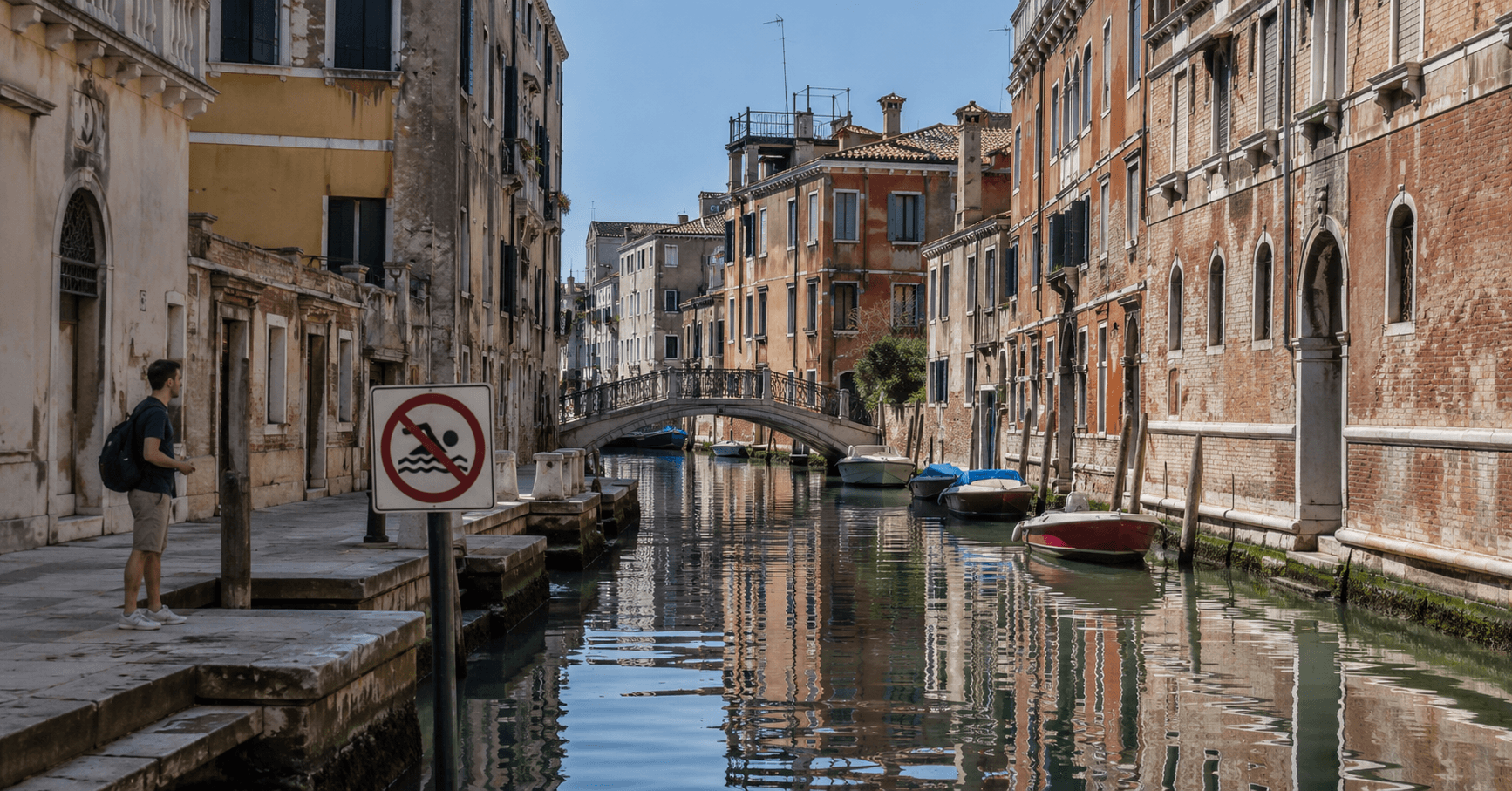
Why Swimming in Venice’s Canals Is Forbidden
The swimming ban in Venice’s canals is not an administrative whim, but stems from a set of very practical reasons concerning the city’s structure. Venice is built on a system of islands connected by canals that have served for centuries as actual communication arteries: vaporettos, water taxis, fire brigade boats, emergency vehicles, freight boats, and gondolas pass through here, often in spaces only a few meters wide. A swimmer in the water, no matter how careful, is virtually invisible to someone steering a motorized vessel, and the consequences of a collision can be extremely severe.
Added to this is a historical-urbanistic factor: Venice does not have a modern, separate sewage network like other Italian cities. Raising the entire city to install underground pipes was never technically feasible; therefore, a large portion of domestic waste flows—after varying treatments depending on the building—directly into the canals. Hotels and larger facilities use more sophisticated purification systems, but the underlying principle remains: the canals of Venice are neither designed nor treated as recreational bodies of water.
What the Law Says: City Regulations, Fines, and Real Cases
The Municipality of Venice regulates the ban through the Urban Police Regulations, which expressly forbid diving, swimming, or even stepping into the water in the historic city’s canals, whether from bridges, banks (fondamente), or directly from boats. The ban applies to everyone, residents and tourists alike, and has no seasonal exceptions: whether it is January or the hottest day of August, the rule does not change.
Anyone caught swimming risks an administrative fine starting at around 350 euros, which can rise further in cases of repeat offenses or particularly dangerous behavior (such as diving from historic bridges or moving boats). In recent years, with the general tightening of rules related to managing tourist flows and the introduction of the city access fee, checks by the local and lagoon police have become more frequent—especially during summer months and in heavily photographed areas like the Grand Canal, Rialto, and the St. Mark’s Basin. Unfortunately, it is not uncommon to read about tourists being fined or even issued exclusion orders (daspo) after diving in for a photo or a social media challenge.
Venice: ACTV Daily Vaporetto Pass
The Real Risks: Water Traffic, Currents and Safety
Beyond the financial penalty, the most serious reason to avoid diving into the canals is physical safety. Venetian canals, especially the Grand Canal and the Giudecca Canal, are continuously navigated by scheduled vaporettos, water taxis, private motorboats, and transport vessels, operating from the early hours of the morning until late past midnight. Boats cannot brake or change course with the speed of a car: a swimmer surfacing between two boats or near a pier risks an impact that, in water, carries far more severe consequences than on land.
Added to this are tidal currents, which in the Venetian Lagoon can be stronger than expected, especially in narrower canals and near locks. The depth itself is far from uniform: it ranges from barely 30 centimeters in minor canals (rii) to over 2 meters in main channels, often with uneven bottoms, piers, submerged steps, and metal structures not visible from the surface. It is not an environment designed for swimming, and this combination of heavy traffic and water unpredictability—even more than the fine—makes swimming in the canals an idea to abandon.
Is the Canal Water Really Dirty?
The water flowing through Venice’s canals is actually lagoon water: a mix of seawater from the Adriatic and freshwater brought by various tributaries flowing into the Venetian Lagoon. Circulation is guaranteed by tidal movements, which twice a day flush water out toward the open sea and bring in fresh water. While this natural mechanism limits stagnation, it is not enough to make the canals suitable for bathing: domestic runoff, constant motorized traffic (with traces of fuel and oils), and concentrated tourist and commercial activities mean that water quality in the inner canals is in no way comparable to that of the lagoon’s beaches or the Adriatic, where health checks are regular and swimming is explicitly authorized.
Where to Swim Legally Near Venice: The Lido and Lagoon Beaches
The good news is that giving up a dip in the canals does not mean giving up the water during a stay in Venice. The city overlooks a lagoon dotted with real, clean, and equipped beaches reachable by vaporetto in just a few minutes from the historic center. The most famous is undoubtedly the Lido of Venice, the thin barrier island separating the lagoon from the Adriatic Sea: here you will find long sandy beaches—both free public areas and equipped beach clubs—suitable for those seeking a classic seaside break after a day among narrow alleyways (calli) and squares (campi). The Lido is also the historic venue of the Venice Film Festival and is connected to the historic center by direct vaporetto lines departing from San Zaccaria and Piazzale Roma.
Beyond the Lido, the Venetian coastline offers other, less crowded bathing areas, such as Punta Sabbioni and the Cavallino-Treporti coast. Both are reachable via vaporetto or Alilaguna in about 30–40 minutes from Venice, making them ideal for combining the sea, equipped beaches, and proximity to the city in a single day. For those staying a few extra days, the island of Sant’Erasmo, while lacking traditional sandy beaches, offers quieter and more authentic lagoon views, perfect for a day trip off the beaten path.

Venice City Pass all Inclusive 72h
How to Truly Experience Venice’s Water (Without Breaking the Rules)
If you aren’t looking to swim but want to experience the special relationship between Venice and its water, there are much more authentic—and legal—ways to do so. The most iconic remains a gondola ride: gliding through the narrowest canals, brushing past the walls of palaces facing minor waterways, and entering the Grand Canal at water level is an experience no dive could replicate, allowing you to discover corners of the city invisible to those walking on the banks. Alternatively, a simple vaporetto ride along the Grand Canal, perhaps at sunset, offers the same immersive feeling while seated comfortably.
For a closer connection to the water without breaking rules, an excellent option is organizing an excursion to the lesser-visited lagoon islands—Sant’Erasmo, Torcello, Burano—where the seascape becomes open and relaxed, far from the center’s heavy traffic. You can also book an authorized private boat tour that includes stops at permitted points in the lagoon.

Private Gondola Ride in Venice (Max 5 Guests)
What Happens If You Get Caught Swimming in the Canals
In the event of an inspection, the procedure is as straightforward as it is discouraging: local or lagoon police officers proceed with identification and immediately issue a fine, which usually sits around 350 euros and can increase in the presence of risky behavior, such as diving from bridges or vessels. In recent years, several incidents of tourists jumping into the Grand Canal or smaller waterways—often filmed and gone viral on social media—have led to stricter enforcement and unflattering media coverage for those involved. It is worth remembering that, beyond the fine, there remains the concrete and far more serious risk of an accident with a passing boat.
Practical Tips for Respecting Local Rules During a Stay in Venice
- Never enter the water in the historic city’s canals, not even for a quick photo or to cool off: the ban applies always, everywhere, and to everyone.
- Head to the Lido of Venice or the beaches of Punta Sabbioni and Cavallino-Treporti via vaporetto if you want to cool off on hot days.
- Plan multi-day transit passes for trips to the islands so you can move around without buying single tickets every time.
- Follow instructions from local and lagoon police: enforcement is frequent in summer months, especially in central areas.
- Choose an authorized gondola ride or boat tour to get close to the water legally and enjoyably.
Frequently Asked Questions About Swimming in Venice’s Canals
- Can you swim in the canals of Venice? No. It is explicitly forbidden by the Urban Police Regulations of the Municipality of Venice to enter the water, swim, or dive into the historic city’s canals at any time of year.
- How much is the fine for swimming in the canals? The administrative fine starts at approximately 350 euros and can increase in cases of particularly dangerous behavior or repeat offenses.
- Is the water in Venice’s canals salt or fresh? It is a mix: it mostly originates from the Adriatic Sea through the lagoon’s inlets, mixed with fresh water from tributaries flowing into the Venetian Lagoon.
- Why isn’t canal water suitable for swimming? Because it partially receives wastewater from city buildings (which lack a separate modern sewage network) and is constantly navigated by motorized vessels.
- Where can you legally swim near Venice? The best options are the beaches at the Lido of Venice, easily reached by vaporetto, and the coastline of Punta Sabbioni and Cavallino-Treporti on the opposite side of the lagoon.
- How deep are the canals of Venice? Depths vary significantly by area: from around 30 centimeters in smaller canals (rii) to over 2 meters in main channels like the Grand Canal.