

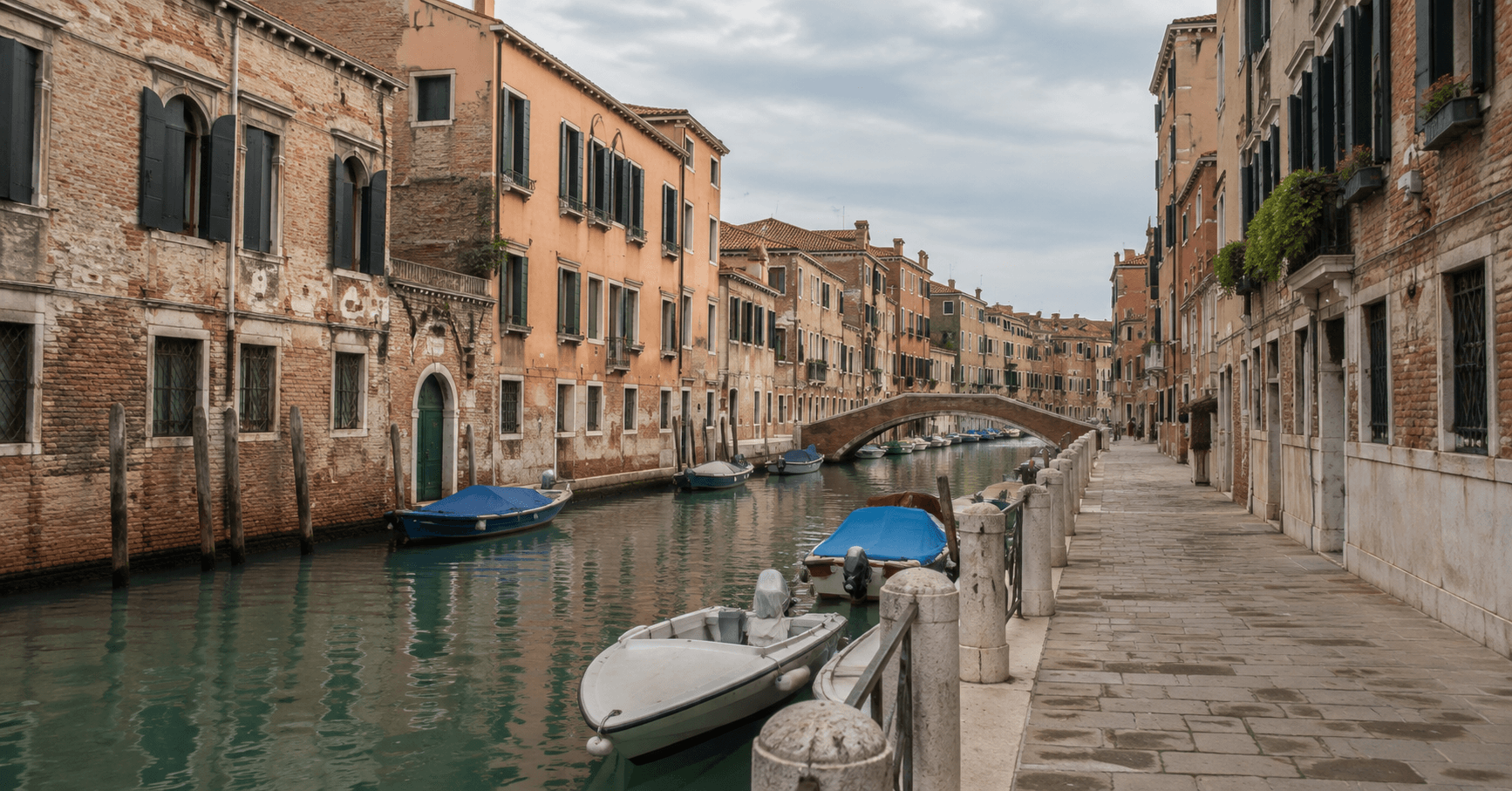
A Sestiere Between Mainland and Lagoon: A Brief History of Santa Croce
The name comes from a now-vanished church, Santa Croce, demolished during the Napoleonic era alongside several other religious buildings in the area. This story encapsulates the district’s dual nature: to the east toward Rialto lies a medieval layout of narrow alleyways and minor canals virtually unchanged for centuries; to the west toward Tronchetto and the port lies land largely reclaimed during the 20th century.
The year 1933 marked the most radical transformation: the opening of the Ponte della Libertà made Santa Croce the only Venetian district accessible by car. It houses Piazzale Roma, the vast bus terminal and parking hub that serves as the initial physical point of contact for millions of visitors. While this role as a transit hub somewhat overshadowed the neighborhood’s authentic soul, Gothic palaces along the Grand Canal, hidden monastery gardens, and a local pace of life flourish just minutes from the terminal.
Ca’ Pesaro: Modern and Oriental Art on the Grand Canal
Santa Croce’s most famous palace is undoubtedly Ca’ Pesaro, a 17th-century Baroque masterpiece designed by Baldassarre Longhena featuring a diamond-pointed rusticated façade reflected in the Grand Canal. Since 1902, it has housed the International Gallery of Modern Art, showcasing works by Gustav Klimt, Wassily Kandinsky, Marc Chagall, and Umberto Boccioni, alongside a major collection of 19th- and 20th-century Venetian art.
On the second floor, the Museum of Oriental Art houses one of Europe’s top Japanese collections, assembled by Prince Henry of Bourbon during a long Asian voyage. Samurai armor, lacquerware, ceramics, and woodblock prints tell the tale of a trade connection as old as Venice itself. Visiting Ca’ Pesaro outside peak hours often means having entire rooms to yourself—a rare luxury in the heart of the city.
San Giacomo dell’Orio: The District’s Spiritual and Public Heart
Nearby Campo San Giacomo dell’Orio is one of the most authentic spots in Venice: tree-lined, informal, and frequented more by locals than tourists. Elderly residents chat on benches while bicycles lean against walls—a rare sight in the lagoon. The church that gives the square its name dates back to the 9th century and presents a fascinating mosaic of styles: a Romanesque layout, a famous inverted ship’s keel ceiling, repurposed Byzantine capitals, and Baroque altars exist side-by-side in a layout reflecting classic Venetian architectural layering.
Small workshops, traditional osterie, and neighborhood shops surround the square, resisting the tourism transformation seen elsewhere. It offers an ideal look at everyday life for year-round Venetians, far from the heavily beaten tracks toward Rialto and San Marco.
San Stae and the Quiet Shores of the Grand Canal
Following the fondamente toward Rialto leads to the Church of San Stae, featuring a dramatic late-Baroque façade adorned with statues directly overlooking the Grand Canal. The interior holds works by Giambattista Tiepolo and Giambattista Piazzetta, but its location is the true highlight: the San Stae vaporetto stop is among the least crowded on the Grand Canal, offering peaceful views of historic palaces.
A bit further along, the Scuola Grande di San Giovanni Evangelista and tiny side alleys offer canal views that few tourists stop to photograph, as most rush past on their way to the Rialto Bridge.
Fondaco dei Turchi and the Natural History Museum
One of the most unusual structures on the Grand Canal sits right in Santa Croce: the Fondaco dei Turchi. This 13th-century Venetian-Byzantine palace served for over two centuries (17th–19th) as the commercial headquarters and residence for Ottoman merchants, symbolizing trade between the Republic and the Ottoman Empire. Today, it houses the Natural History Museum of Venice, featuring the fossil skeleton of an Ouranosaurus nigeriensis alongside exhibits on the lagoon’s ecosystem.
Though often overlooked in favor of Venice’s art scene, it is a great stop for families or anyone seeking a different perspective on the city’s natural and commercial past.
Venice 11 Museum Pass + Skiptheline Entry to Doge's Palace
Palazzo Mocenigo and the Fragrance of 18th-Century Venice
Just steps from San Stae, Palazzo Mocenigo houses a museum dedicated to textiles, costumes, and perfumery. Frescoed rooms furnished as an 18th-century noble residence show Venetian aristocratic life through period clothing, accessories, and a permanent section on the history of perfume—a trade in which Venice was a major European hub for spice and essence imports from the East.
It offers an uncrowded look into the interior life of the noble palaces lining the canals.
Bacari, Markets, and Everyday Life in the Calli
Santa Croce, along with neighboring San Polo, remains a great place to find traditional bacari and osterie. Here, cicchetti are served at the counter with an ombra (a small glass of wine) without multilingual tourist menus. Walking through the alleys connecting San Giacomo dell’Orio to San Stae reveals artisan shops, historic grocers, and quiet courtyard squares (campielli).
This area captures the distinction between postcard Venice and daily local life, making Santa Croce a valuable stop for repeat visitors seeking something off the main routes.
A Walking Itinerary to Discover Authentic Santa Croce
For a half-day visit, start at Piazzale Roma or Santa Lucia Station, crossing the Ponte della Costituzione or walking along the Grand Canal toward San Simeon Piccolo, recognizable by its green dome. From there, head toward the Fondaco dei Turchi and the Natural History Museum, then head inward through the calli to San Giacomo dell’Orio for a break at a local bàcaro.
Continue toward San Stae and Ca’ Pesaro, wrapping up at Palazzo Mocenigo or walking a few minutes further to the Rialto Bridge. The stroll takes about two to three hours at a relaxed pace including museum stops, bypassing the heavy crowds near San Marco.
Venice: hidden and unusual walking Tour
Getting To and Around Santa Croce
Santa Croce is Venice’s most accessible district. Drivers and bus passengers arrive at Piazzale Roma or Tronchetto, while train travelers arrive at Santa Lucia Station, a short walk from the boundary. Vaporetto stops at Riva de Biasio, San Stae, and Ferrovia quickly connect Santa Croce to the rest of Venice, making it a convenient base for trips to Rialto, San Marco, or the outer islands.
Walking remains the best way to explore, as internal distances are short and most spots in this guide sit within a 10- to 15-minute walk of one another.
Venice: ACTV Daily Vaporetto Pass
FAQ: Santa Croce in Venice
- Is Santa Croce touristy?Only in parts. Piazzale Roma sees high visitor traffic as a transit hub, but most people move straight toward Rialto or San Marco. The interior areas between San Giacomo dell’Orio and San Stae remain among the quietest sections of the historic center.
- What should I see in Santa Croce in a few hours?Key sights include Ca’ Pesaro, the Church of San Giacomo dell’Orio, San Stae, the Fondaco dei Turchi (Natural History Museum), and Palazzo Mocenigo. A 2- to 3-hour walk easily links them all.
- How do I get to Santa Croce from St. Mark’s Square?Walking takes roughly 20–25 minutes through San Polo. Alternatively, take the vaporetto along the Grand Canal to San Stae or Riva de Biasio, which is faster when carrying luggage or during hot weather.
- What does the Venice City Pass include for Ca’ Pesaro?The Venice City Pass All Inclusive offers skip-the-line access to the Doge’s Palace and 11 civic museums (including Ca’ Pesaro and the Natural History Museum), along with optional ACTV vaporetto travel for your selected duration.
- Which Santa Croce museums are included in official city passes?Ca’ Pesaro (International Gallery of Modern Art & Museum of Oriental Art) and the Natural History Museum at Fondaco dei Turchi are included in both the Venice City Pass and the Venice 11 Civic Museums Pass.
- Is Santa Croce good for families with children or visitors seeking quiet areas?Yes. Open squares like Campo San Giacomo dell’Orio, lower tourist density, and the dinosaur skeleton at the Natural History Museum make it a family-friendly option away from the crowds at San Marco.
Related Articles