

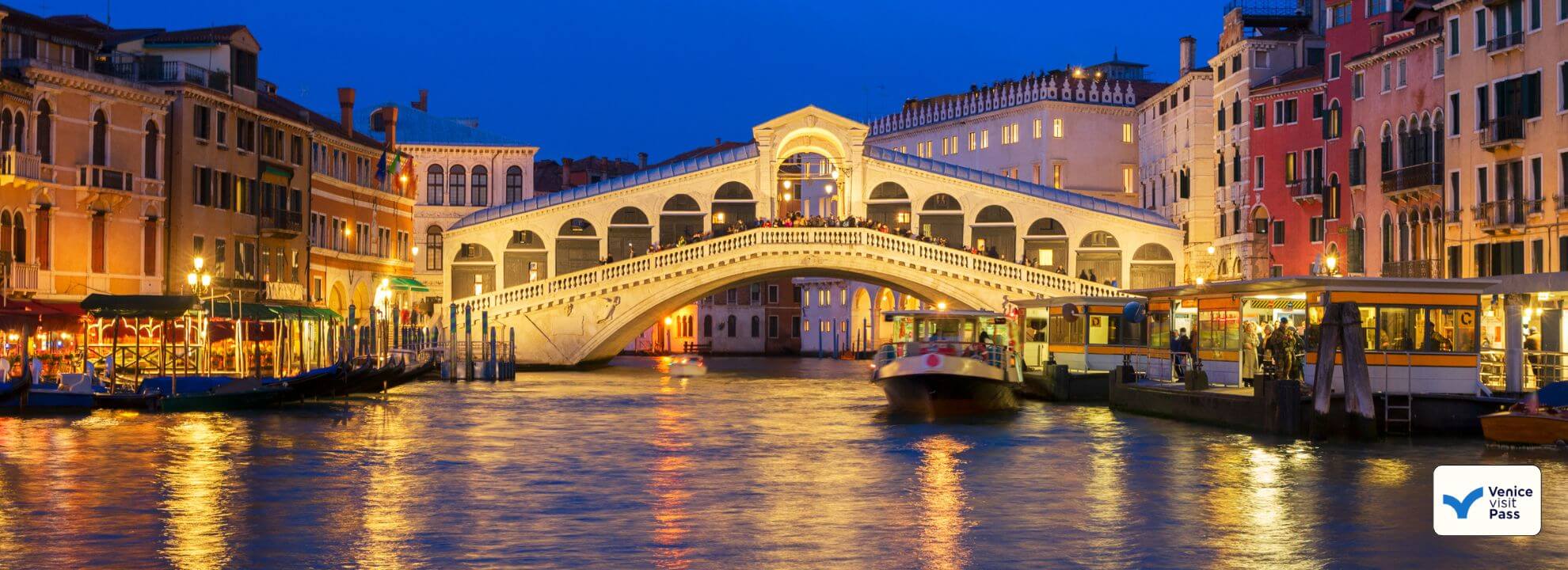
The history of the Rialto Bridge
The bridge we see today is not the first to cross the Grand Canal at this spot: before it, several wooden crossings came and went, destroyed by fires and collapses. The stone version we know today was completed in 1591, designed by architect Antonio da Ponte, who was chosen over illustrious competitors like Palladio and Sansovino. Its single-span structure, supported by two rows of lateral arches, was considered an engineering gamble at the time: many feared that the large Istrian stone arch would not hold the weight.
The bridge has always been more than just a crossing; it is also a small elevated shopping center. The shops nestled along both sides still sell Murano glass, fabrics, and souvenirs today, just as they did in past centuries when they hosted goldsmiths and cloth merchants.

Venice: Shared Gondola Ride Across the Grand Canal
What to see around the Bridge
At the foot of the bridge, on the San Polo side, lies the Rialto Market, one of the oldest markets in Europe. The section dedicated to fish (the Pescaria) and the one with fruit and vegetables are active from early morning. They remain among the most authentic sights in the city, far from the tourist crowds of St. Mark’s Square.
From the bridge, a short walk takes you to St. Mark’s Square, the Basilica, and the Doge’s Palace, which together with the Rialto form the classic route for a first-time visit to Venice.
To plan your route towards St. Mark’s, you might also be interested in: How to get to the Doge’s Palace in Venice: transport, distances, and best times to visit
St. Mark's Museums with Doge's Palace Skip-the-line Ticket + Digital Guide
Starting from 24,99 €Book
Practical tips for visiting the Rialto Bridge
- Choose the right time. The bridge is extremely crowded from 10:00 AM to 6:00 PM. To photograph it without the crowds, go before 9:00 AM or after sunset, when the warm light enhances the Istrian stone.
- Wear comfortable shoes. The steps of the bridge and the surrounding streets (calli) are paved and become slippery with rain or high tide (acqua alta).
- Keep the incline in mind. The bridge has a stepped ramp on both sides; therefore, it is not easily accessible with heavy strollers or wheelchairs without assistance—a detail to consider if you are traveling with toddlers or people with reduced mobility.
- Visit the market in the morning. If you want to see the Rialto Market in action, arrive by 12:00 PM. In the early afternoon, the fish and vegetable stalls close.
How to get to the Rialto Bridge
The easiest way to get there is by ACTV water bus (vaporetto): the Rialto and Rialto Mercato stops are served by lines 1 and 2, which run along the entire Grand Canal. If you arrive from Marco Polo Airport, you can reach Venice by water and then take a vaporetto to the bridge.
Venice: ACTV Daily Vaporetto Pass
If you are arriving directly from the airport and prefer a direct boat connection to the historic center, you can also consider a dedicated transfer.
Alilaguna Pass 24h-72h: boat transfer in Venice
An unmissable experience
Within just a few dozen meters, the Rialto Bridge encapsulates the commercial history, engineering, and daily soul of Venice. Whether you cross it on foot, admire it from a gondola, or use it as a starting point toward St. Mark’s, it deserves more than a quick photo.
The bridge changes its face depending on the time of day: early in the morning, while the shops are still raising their shutters, you can breathe in the atmosphere of a neighborhood waking up, with the first deliveries to the market and few tourists around. In the middle of the day, it becomes the liveliest and most crowded spot in the district, crossed by residents, vendors, and visitors in a continuous bustle. At sunset, however, the Istrian stone glows with warm tones and the water traffic slows down, offering a quieter and more photogenic view.
The vantage point also makes a difference: from above, walking among the shops, you experience the bridge as a place of passage and trade; from below, by boat or from the banks of the Grand Canal, you can appreciate its architectural structure and its imposing scale compared to the small boats passing underneath.
For this reason, it is worth doing more than a single crossing: returning at different times of the day—perhaps combining a walk across it with a gondola ride—allows you to catch nuances that a single visit might miss, and to understand why for Venetians, the Rialto is much more than a postcard attraction.
FAQ about the Rialto Bridge
- How much does it cost to cross the Rialto Bridge? Crossing is free: the bridge is a public thoroughfare of the city. You only pay for any additional experiences, such as a gondola ride or tickets for nearby museums and monuments.
- What is the best way to reach the Rialto Bridge? The vaporetto is the most convenient option: lines 1 and 2 stop at Rialto and Rialto Mercato respectively. Alternatively, the bridge can be reached on foot in 10-15 minutes from St. Mark’s Square or Santa Lucia Station.
- When was the Rialto Bridge built? The current stone bridge was completed in 1591 based on a design by Antonio da Ponte, after centuries during which the crossing had been made of wood and rebuilt several times.
- When is the best time of day to visit without crowds? Early morning (before 9:00 AM) and evening after sunset are the quietest times, offering the best light for photographs.
- What is located in the immediate vicinity of the bridge? On the San Polo side, you will find the Rialto Market, with areas dedicated to fish, fruit, and vegetables. From the bridge, you can also walk to St. Mark’s Square, the Basilica, and the Doge’s Palace.
- Is the Rialto Bridge accessible with a stroller or wheelchair? The bridge has steps on both sides of the central span, so it is not fully accessible without assistance. Those traveling with heavy strollers or with mobility difficulties may want to consider alternative routes along the banks.
- Is it possible to visit the Rialto Bridge with a guide? Yes, several walking tours of Venice include a stop at the Rialto Bridge along with other landmarks like St. Mark’s Square and the Doge’s Palace, often with skip-the-line entry to the main monuments included.