

![Passeggiare_a_Venezia__6_itinerari_indimenticabili-copyright-credit-canva[1]](https://www.venicevisitpass.com/wp-content/uploads/2025/08/Passeggiare_a_Venezia__6_itinerari_indimenticabili-copyright-credit-canva1.jpg)
St. Mark’s Square
Ideal for: Admiring Venice’s iconic landmarks
- Distance: Just over 1 km
- Difficulty: Easy, flat route
- Time from city center: 1 minute
Venice’s most iconic walk starts at the Ponte della Paglia, the vantage point to view the Bridge of Sighs framed between the Doge’s Palace and the historic Prisons. It is one of the most photographed spots in the city, especially in the early morning light before the tour groups arrive. From here, step into St. Mark’s Square, Venice’s living room, dominated by St. Mark’s Basilica with its Byzantine domes and the Doge’s Palace—the seat of the Republic’s power for centuries. Take time to stroll under the Procuratie, look up at the Campanile towering over the square, and relax in the Royal Gardens, a green oasis right by the water.
Continuing toward the Teatro La Fenice—the opera house rebuilt multiple times after historic fires—you will reach the Baroque facade of the Church of Santa Maria del Giglio, adorned with statues celebrating the Barbaro family. The walk finishes at Palazzo Grassi, now an exhibition venue for the Pinault Collection and a focal point for contemporary art in the city.
- Starting Point: St. Mark’s Square (Open 24 hours)
- Recommended Time: Between 8:30 AM and 11:00 AM, when the square is quietest

Tickets for the Bell Tower and the historic gallery of St. Mark's Square
Dorsoduro
Ideal for: Art, museums, and culture lovers
- Distance: Approximately 1 km
- Difficulty: Easy, flat
- Time from city center: 10 minutes by water bus (vaporetto)
Dorsoduro is the district of artists and students, offering a more relaxed atmosphere than the tourist core of San Marco. Starting from the Salute pier, you reach Punta della Dogana—the former sea customs house turned exhibition space—and nearby, the Peggy Guggenheim Collection, one of Europe’s premier modern art museums located in the collector’s former Grand Canal residence.
Crossing the wooden Ponte dell’Accademia offers one of the finest views across the Grand Canal and leads directly to the Gallerie dell’Accademia, home to masterpieces by Titian, Tintoretto, and Bellini. Continuing along Fondamenta Nani, you will encounter the Squero di San Trovaso, one of the last historic shipyards where gondolas are still crafted and repaired by hand using generations-old techniques. The final stop is Ca’ Macana, a historic papier-mâché mask workshop where you can observe traditional Venetian craft techniques.
- Starting Point: Fondamenta Salute
- Recommended Day: Avoid Tuesdays, when some museums are closed

Venice: Shared Gondola Ride Across the Grand Canal
Rialto and San Polo
Ideal for: Historic markets and architecture
- Distance: Approximately 800 meters
- Difficulty: Easy, with steps over the bridge
- Time from city center: 7 minutes
The Rialto Bridge is the perfect starting point to explore one of Venice’s liveliest districts. Built in the late 16th century to a design by Antonio da Ponte, it remains the busiest crossing on the Grand Canal and a prime location to admire Renaissance architecture like Palazzo dei Dieci Savi and Palazzo Dolfin Manin.
Descending into San Polo, the alleyways fill with bàcari—traditional Venetian taverns ideal for enjoying a glass of wine (ombra) and bite-sized snacks (cicchetti)—alongside independent artisan shops. The vibrant heart of the district is the Rialto Markets, open early in the morning: the Pescaria (fish market) and the Erberia (produce market). A short walk away stands San Giacomo di Rialto, traditionally considered Venice’s oldest church, and the Gobbo di Rialto, a stone statue historically used as a podium for official public proclamations.
- Starting Point: Rialto Bridge
- Recommended Time: Early morning, between 7:30 AM and 9:00 AM, when the market is at its peak
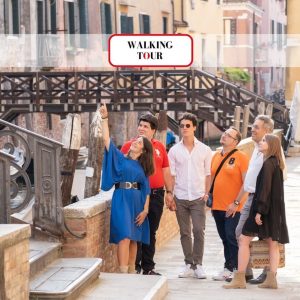
Venice: hidden and unusual walking Tour
Cannaregio
Ideal for: Discovering Jewish history and quiet streets
- Distance: Just over 1 km
- Difficulty: Easy, with a few steps
- Time from city center: 23 minutes by ferry
Cannaregio is Venice’s largest and least crowded district, defined by wide canals lined with fondamenta where everyday local life continues away from the crowds. The core of this walk is the Jewish Ghetto, established in 1516 as the world’s first ghetto. Its 16th-century synagogues offer deep insight into Venetian Jewish heritage, while the Jewish Museum of Venice houses historical texts and ceremonial objects. Local bakeries in the area offer traditional Venetian-Jewish pastries.
Further along stands Ca’ d’Oro, one of the most ornate Gothic palaces on the Grand Canal, and the Church of Madonna dell’Orto, housing major paintings by Jacopo Tintoretto, who is buried inside. A final highlight is Ponte Chiodo, one of Venice’s last remaining bridges without parapets, showcasing how all canal crossings used to look. Nearby at Fondamente Nove, water buses depart directly to the lagoon islands.
- Starting Point: Campo San Geremia
- Recommended Day: Avoid Saturdays, when the Jewish Museum and synagogues are closed
Venice: hidden and unusual walking Tour
Burano Island
Ideal for: Vibrant colors and traditional lacemaking
- Distance: Less than 1 km
- Difficulty: Easy
- Time from city center: 1 hour 15 minutes by water bus
Burano is renowned for its brightly painted houses reflecting off the canals—a tradition said to have helped returning fishermen spot their homes through the lagoon fog. Walking through Burano’s streets reveals the historic art of needle lacemaking, practiced by local women since the 16th century. The Lace Museum (Museo del Merletto) documents this heritage, while local artisan shops allow visitors to see the delicate handiwork in progress.
Following the walk toward the wooden Wander Bridge brings you to the quiet Fondamenta Pontinello Destra, offering picturesque views away from the main tourist trail. If time permits, pair your visit with nearby Murano, famous for its glassblowing heritage and accessible on the same transit ticket.
- Starting Point: Burano “C” water bus stop
- Recommended Time: Late afternoon, just before sunset, when the golden light enhances the colorful facades
Giudecca
Ideal for: Panoramic skyline views
- Distance: Nearly 5 km
- Difficulty: Easy, with a few steps
- Time from city center: 21 minutes by ferry
Separated from the historic center by the wide Giudecca Canal, this long island offers panoramic views across the city skyline alongside a quieter, residential atmosphere. Starting near the Giudecca Palanca stop, visitors on Friday mornings can explore the local Sacca Fisola market. Across the water, the wide Fondamenta delle Zattere promenade is a favorite local spot for evening strolls.
The path leads to the Church of the Santissimo Redentore, Andrea Palladio’s architectural masterpiece built to give thanks after the plague of 1576, which remains the centerpiece of the annual Festa del Redentore in July. Towards the tip of the island, the views across the basin toward St. Mark’s Campanile are among the finest in the city. End the walk with a brief boat ride to San Giorgio Maggiore, where ascending the church’s bell tower yields 360-degree views over the lagoon with far fewer crowds than St. Mark’s.
- Starting Point: Giudecca Palanca “A”
- Recommended Time: Friday morning for the local market, or late afternoon for the best light over the lagoon
FAQ – Best Walks in Venice
-
How long do you need to explore Venice on foot?
A 2-to-3-day trip is sufficient for main highlights like St. Mark’s Square, Rialto, and Dorsoduro. To explore off-the-beaten-path districts like Cannaregio and Castello alongside the lagoon islands, plan for at least 4 to 5 days. -
Which is the best walk in Venice?
It depends on your preference: iconic landmarks are concentrated around St. Mark’s Square, while Cannaregio and Castello offer a more authentic atmosphere. Burano and Lido are ideal for scenic views distinct from the historic center. -
Can you explore Venice on foot in a single day?
Yes, key central sights (San Marco, Rialto, Dorsoduro) can be covered during an intensive single-day walk. However, visiting lagoon islands like Burano or Lido requires water bus travel that is best enjoyed at a relaxed pace. -
How do you travel between districts comfortably?
ACTV water buses (vaporetti) connect all main districts and lagoon islands. The Alilaguna ferry provides direct routes connecting Lido, Murano, and Burano to the airport and historic center. -
What shoes should you wear in Venice?
Comfortable walking shoes with slip-resistant soles are essential for navigating stone paving and the city’s numerous stepped bridges, which can get slippery during rain or high tide (acqua alta) events.