

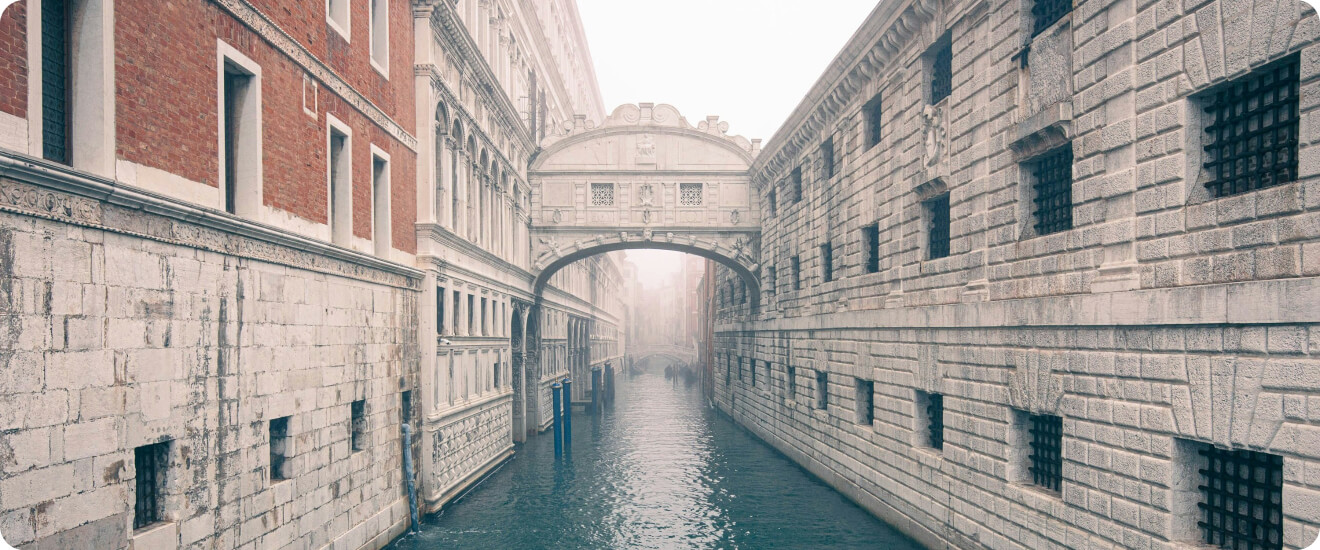
1. Doge’s Palace (Palazzo Ducale)
Located in St. Mark’s Square, the Doge’s Palace is an undisputed symbol of Venice. This extraordinary example of Venetian Gothic architecture served not only as the Doge’s residence, but also as the seat of government, law courts, and prisons of the Republic: for over a thousand years, all the power of the Serenissima flowed through these halls.
The tour meanders through monumental spaces like the Great Council Hall (Sala del Maggior Consiglio), decorated with canvases by Tintoretto and Veronese, and more austere spaces, such as the prison cells reached by crossing the famous Bridge of Sighs. According to legend, this was where the condemned caught their last glimpse of the lagoon before entering the New Prisons.
Highlights include Tintoretto’s Paradise—one of the largest oil paintings in the world—and the gilt wooden ceiling of the Senate Hall. The visit offers a deep understanding of the political system of the Serenissima while admiring Venetian art masterpieces in a unique architectural setting.
Visiting Time & Planning
Allow about 90–120 minutes for a complete visit. The Doge’s Palace is among the city’s busiest attractions; ticket lines can exceed an hour during peak months. Booking a skip-the-line timed-entry ticket online is the most practical choice, especially from April to October.
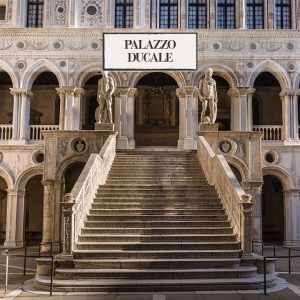
Doge's Palace Reserved Entry Ticket
Visiting the rest of St. Mark’s Square? The St. Mark’s Square Museums Ticket with skip-the-line entry to the Doge’s Palace also includes the Correr Museum, the National Archaeological Museum, and the Marciana National Library.
Panoramas: Priority access tickets for the St. Mark’s Campanile and Historical Gallery are also available.
2. Peggy Guggenheim Collection
Overlooking the Grand Canal, the Peggy Guggenheim Collection is one of the most important modern art museums in Italy. Housed in Palazzo Venier dei Leoni—an unfinished 18th-century building—it was the Venetian home of the renowned American art patron and collector, who arrived in post-WWII Venice with one of the boldest private collections of her era.
The permanent collection features works by Picasso, Pollock, Kandinsky, Magritte, Dalí, and other major 20th-century figures. The visit is a journey through 20th-century artistic experimentation across Surrealism, Cubism, Abstract Expressionism, and European/American avant-gardes. The museum also hosts international temporary exhibitions on the ground floor.
Don’t miss the sculpture garden—an outdoor space along the canal displaying works by Giacometti, Arp, and Moore—and the terrace overlooking the Grand Canal where Peggy once entertained guests. An on-site café and a bookstore specializing in modern and contemporary art are also available.
Practical Tips
- Recommended visit time: 60–90 minutes.
- Closure: Closed on Tuesdays. Check updated opening hours before planning.
- Location: Located in the Dorsoduro district, easily accessible on foot from Ca’ Rezzonico or by vaporetto (Accademia/Salute stops).
3. Gallerie dell’Accademia
The Gallerie dell’Accademia holds the vastest collection of Venetian painting spanning from the 14th to the 18th century. Set in the ancient complex of the Scuola della Carità (which includes a church and a monastery suppressed in the Napoleonic era), the Galleries offer a chronological narrative of Venetian artistic output.
The collection features masterpieces by Titian, Tintoretto, Veronese, Bellini, Carpaccio, and Giorgione, including Giorgione’s mysterious The Tempest and Carpaccio’s Miracles of the True Cross cycle. Leonardo da Vinci’s iconic Vitruvian Man drawing is housed here, though displayed only on special occasions due to conservation requirements.
Recent renovations have enhanced the display spaces, broadening the layout and making it more engaging with newly dedicated rooms for the Venetian Renaissance and a refreshed presentation.
Practical Tips
- Recommended visit time: 75–90 minutes for a full walkthrough.
- Location: Situated right next to the Accademia Bridge, an ideal starting point for exploring Dorsoduro or heading toward St. Mark’s.
- Crowds: Ticket queues lengthen on weekends and during summer; opt for early morning entry times to avoid the busiest hours.
4. Natural History Museum
Lesser-known to casual tourists compared to the major art museums, the Natural History Museum of Venice is a delight for both adults and children. Housed in the Fontego dei Turchi—a Venetian-Byzantine palace on the Grand Canal that served as the long-time headquarters for Ottoman traders—the museum presents the story of life on Earth through an interactive, educational layout.
Exhibits include collections of fossils, minerals, taxidermy, and dinosaur skeletons—notably the impressive Ouranosaurus nigeriensis, one of the museum’s most photographed highlights—alongside displays on biodiversity and adaptation. Multimedia installations, aquariums, and interactive spaces make it ideal for families seeking a break from classic art tours.
It also serves as a great rainy-day alternative (common in Venice during autumn and winter) or a refreshing midday pause.

Venice Natural History Museum Ticket
5. Ca’ Rezzonico
Ca’ Rezzonico is one of the most stunning palaces on the Grand Canal, transformed into a museum dedicated to 18th-century Venice. Designed by Baldassarre Longhena (architect of the Santa Maria della Salute Basilica) and completed decades later by Giorgio Massari, its frescoed rooms and period furnishings offer a vivid look into pre-Napoleonic Venetian aristocratic life.
The museum displays paintings by Tiepolo, Guardi, Longhi, and Canaletto, alongside original period furniture and decorative arts like porcelain, tapestries, and sculptures. The grand ballroom, featuring frescoed ceilings and Murano glass chandeliers, stands as one of the city’s most photographed interiors.
Practical Tips
- Recommended visit time: 60–75 minutes.
- Location: Located in Dorsoduro with its own vaporetto stop on the Grand Canal, positioned between the Gallerie dell’Accademia and the Piazzale Roma hub.
- Passes: The museum belongs to the Civic Museums of Venice (MUVE) network; if you plan to visit multiple sites, a multi-museum pass is recommended.
Choosing the Right Venice Museum Ticket
Buying single tickets isn’t always the most cost-effective approach for multiple visits. The Doge’s Palace, Natural History Museum, and Ca’ Rezzonico belong to the Civic Museums of Venice (MUVE) network (covering 11 sites including Museo Correr, Ca’ Pesaro, Palazzo Fortuny, and Teatro La Fenice). A single combined ticket saves both time and money.
Conversely, the Peggy Guggenheim Collection and Gallerie dell’Accademia are independent/state-run institutions and require separate admission tickets.
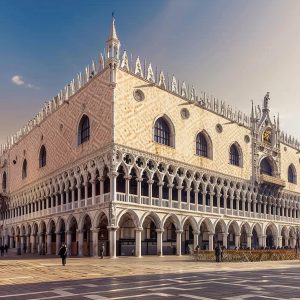
Venice 11 Museum Pass + Skiptheline Entry to Doge's Palace
Need public transit included? The Venice City Pass All Inclusive 72h covers entry to the Doge’s Palace, the 11 civic museums, Teatro La Fenice, Scuola Grande dei Carmini, and Fondazione Querini Stampalia, alongside unlimited 72-hour vaporetto transit.
In short: If staying in Venice for just a couple of days to focus on art and history, the 11-Museum Venice Pass is your most efficient option. If you also need frequent water-bus transport around the lagoon islands, choose the 72h All-Inclusive City Pass to avoid separate transit purchases.
Venice Museums FAQ
- How many days are needed to visit the main museums?Two full days allow comfortable visits to all five museums featured in this guide, leaving ample room for breaks and strolling. With only one day available, focus on the Doge’s Palace plus one major art venue (either the Accademia or Guggenheim).
- Is advance booking recommended?Yes—especially for the Doge’s Palace during peak season (April–October) and Carnival. Timed online entry lets you skip ticket counter lines that often exceed an hour.
- Which museums are best for families with kids?The Natural History Museum, with its dinosaur skeletons and interactive displays, is top-rated for children. The Doge’s Palace also captivates younger visitors with its historic armories, secret corridors, and prison cells.
- Are Venice museums accessible for visitors with reduced mobility?The Doge’s Palace, Gallerie dell’Accademia, Ca’ Rezzonico, and Peggy Guggenheim Collection feature step-free routes and elevators, though some historic areas may retain step thresholds. Checking current accessibility details ahead of your visit is recommended.