

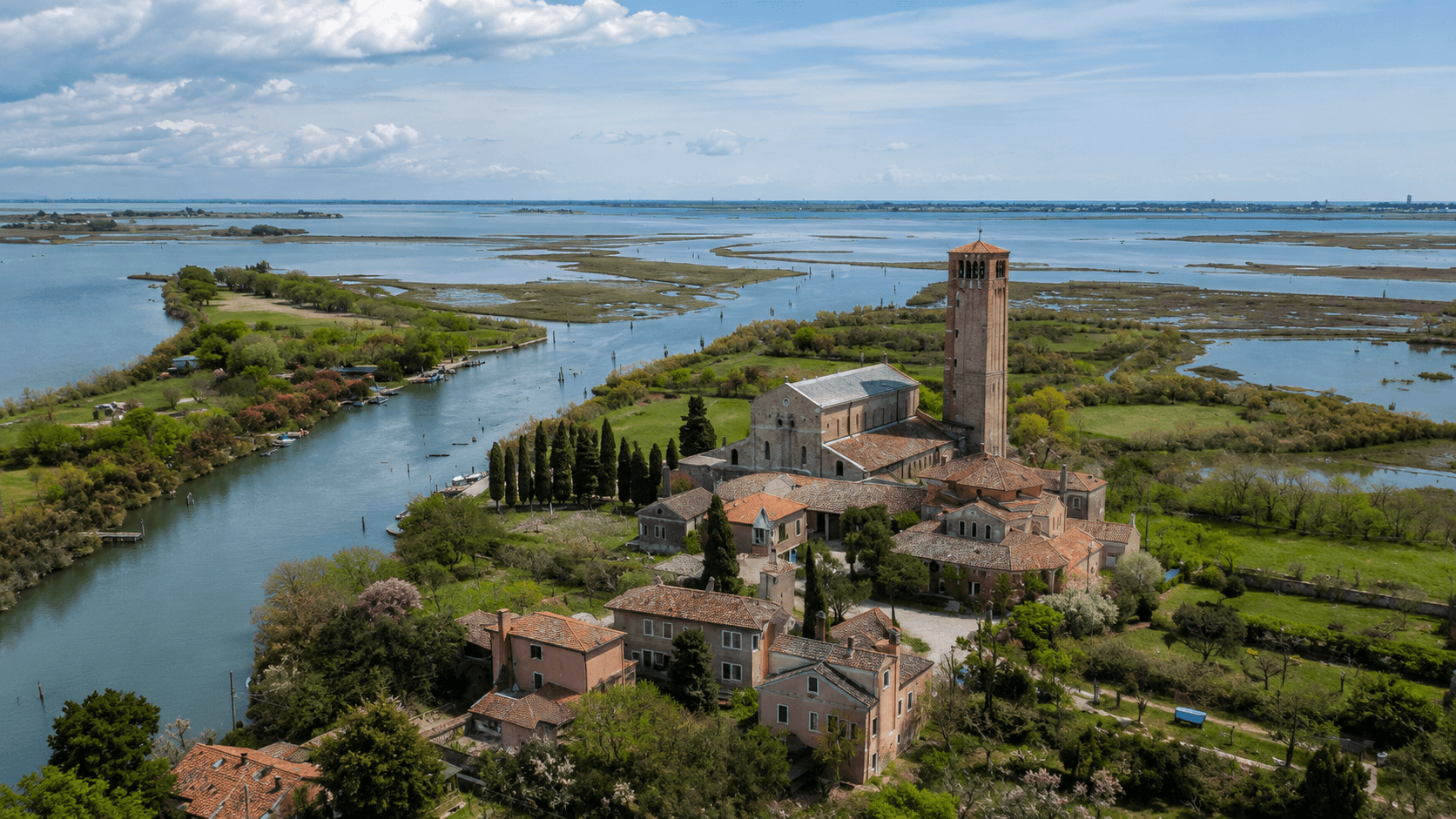
Where Torcello Is Located and How to Get There
Torcello is located in the northern part of the Venetian lagoon, a few minutes by boat from Burano and about 45–50 minutes from the historic center. It is connected to the mainland and other islands via line 12 of the ACTV water buses (vaporetti), which departs from Fondamente Nove and stops at Murano, Mazzorbo, Burano, and Torcello.
Since there is no real town center, the visit takes place almost entirely on foot, following the single paved path that leads from the boat dock to the main square, running along the ancient navigable canal once used by merchants.
Venice: ACTV Daily Vaporetto Pass
To reach the island in the easiest and most economical way, it is recommended to get a transit pass valid on ACTV lines, allowing you to move freely between Venice, Murano, Burano, and Torcello without having to buy single tickets at every stop. Those who prefer a single round trip can opt for a standard ticket, valid for 75 minutes from validation and sufficient for a single ride to the islands.
Venice vaporetto Ticket ACTV - 75 minutes
The History of Torcello: The Cradle of Venice
Long before Venice arose, Torcello was already a thriving center. Historical sources trace its founding to 452 AD, when the inhabitants of the Roman city of Altinum, on the mainland, took refuge in the lagoon to escape the invasions of the Huns led by Attila. During the 7th century, the bishop’s see of Altinum was transferred to Torcello, which thus became an important religious and administrative hub.
Between the 7th and 10th centuries, the island experienced its period of maximum splendor: it is estimated that, at its peak, Torcello had a population of several thousand inhabitants, an active port, thriving trades in salt and textiles, and a political leadership role over the lagoon’s other communities. It was in Torcello that the government of the lagoon islands met for a long time before the seat of power moved to Rialto in 811, marking the beginning of the rise of what would become Venice.
The progressive decline of Torcello began between the 12th and 14th centuries, caused by a combination of factors: the silting up of navigable canals, the resulting spread of malaria in swampy areas, and the shift of trade routes toward Rialto—by then the nerve center of the new lagoon city. Inhabitants gradually abandoned the island, even carrying away building materials from their houses to reuse in constructing new buildings in Venice. Today, Torcello counts barely a handful of permanent residents, a number that makes the contrast between its glorious past and present quiet even more evocative.
The Legends of Torcello
Precisely because it is an ancient and somewhat mysterious place, Torcello has given birth over the centuries to several legends, passed down orally by the lagoon’s inhabitants and still told to visitors today.
Attila’s Throne: In the island’s main square, in front of the Basilica, stands an ancient stone seat dubbed by popular tradition “Attila’s Throne.” Legend has it that the feared commander of the Huns sat on this very throne during his raids in the Veneto territory. Historians, however, believe it to actually be an ancient bishop’s seat or a civil tribunal used by local authorities to administer justice; the name tied to Attila is thus a later popular addition created to make the artifact’s history even more fascinating and mysterious.
The Devil’s Bridge: Short distance from the square lies the Devil’s Bridge (Ponte del Diavolo), one of the rare Venetian bridges left without parapets, just as all lagoon bridges once were. The name stems from a legend about a young Venetian woman in love with an Austrian soldier killed in battle: desperate, the girl allegedly turned to a witch to bring him back to life, resulting in the devil himself building the bridge in a single night in exchange for the souls of seven unbaptized children. Folk tale aside, the medieval bridge represents one of the most photographed and iconic sights on the island.
What to See in Torcello
Despite its small size, Torcello preserves an artistic heritage of extraordinary value, so much so that it is considered an essential stop for anyone wishing to discover the true historical roots of Venice.
Basilica of Santa Maria Assunta: The island’s most important monument and one of the oldest in the entire lagoon. Its foundation dates back to 639 AD, with subsequent rebuilds in 864–867 and in 1008, the year to which its present appearance is attributed. The interior holds some of the finest and best-preserved Byzantine mosaics in the Veneto region, notably the monumental Last Judgment on the counter-facade and the solemn Madonna and Child set against a gold background in the apse. Next to the church stands the 9th-century baptistery, among the oldest surviving examples of sacred architecture in the area.
Church of Santa Fosca: Adjacent to the Basilica, the Church of Santa Fosca is a central-plan building surrounded by an elegant columned porch, built between the 11th and 12th centuries to house the saint’s relics. Its style, influenced by Byzantine architecture, makes it one of the most harmonious and elegant religious structures in the lagoon.
Provincial Museum of Torcello: Founded in 1889, the museum occupies two 14th-century palaces facing the square—the Palazzo del Consiglio and the Palazzo dell’Archivio. It gathers archaeological artifacts, medieval artworks, and historical testimonies of the island, offering a complete overview of Torcello’s evolution from the Roman era to the Middle Ages.
The Square and Bell Tower: The heart of the island is the small square overlooked by the Basilica, the Church of Santa Fosca, and the museum palaces. From here, you can also climb the Basilica’s bell tower for a panoramic view over the lagoon that reaches Burano and, on clear days, Venice itself.
Combining a Visit to Torcello with Murano and Burano
Many visitors choose to dedicate a full day to exploring the northern lagoon islands, combining Torcello with the more famous Murano and Burano. This type of itinerary lets you alternate the historical and almost mystical atmosphere of Torcello with the glassmaking tradition of Murano and the vivid colors of Burano’s houses, making for a day that highlights three very different faces of the Venetian lagoon.
For those who prefer not to arrange transit independently, a guided tour offers a practical solution: visiting a Murano glass factory with a live glassblowing demonstration is often the best way to start the day before continuing to the other islands via scheduled public water buses.
Practical Tips for the Visit Torcello can be comfortably visited in two to three hours—enough time to walk to the main square, visit the Basilica and the Church of Santa Fosca, and stop by the Devil’s Bridge. Since the island has very few tourist services, it is advisable to schedule your visit during early morning or early afternoon hours, when the light is most favorable for admiring the Basilica’s mosaics.
If you wish to visit Torcello alongside other Venice attractions during your stay, consider a tourist pass that includes public transport to the lagoon islands to avoid buying separate tickets for each leg of the journey.
Venice City Pass all Inclusive 72h
Frequently Asked Questions About Torcello
- How far is Torcello from the center of Venice?Torcello is about 45–50 minutes by water bus from Fondamente Nove via ACTV line 12, which connects Venice to Murano, Mazzorbo, Burano, and finally Torcello.
- How much time is needed to visit Torcello?Two to three hours are generally enough to comfortably visit the main square, the Basilica of Santa Maria Assunta, the Church of Santa Fosca, and the Devil’s Bridge.
- Why is Torcello considered the cradle of Venice?Because it was settled and populated starting in 452 AD, several centuries before Venice was founded, and was for a long time the lagoon’s most important political and religious center before the government moved to Rialto in 811.
- What is Attila’s Throne?It is an ancient stone seat located in the island’s main square. Popular tradition links it to the commander of the Huns, but historians consider it more likely to have been a bishop’s seat or a civil tribunal.
- Can you visit Torcello together with Murano and Burano on the same day?Yes, it is one of the most popular combinations for visitors. The three islands are connected by the same water bus line, allowing you to experience very different atmospheres in a single day.
- Are there entrance fees for Torcello?The island itself is freely accessible. Paid entry applies to the Basilica of Santa Maria Assunta, the Church of Santa Fosca, and the Provincial Museum, which can be visited individually or with a combined ticket.
You Might Also Be Interested In