

Venice: Guided Tour of the Palace and Prisons of the Lords of the Night
Origin and function of the Lords of the Night
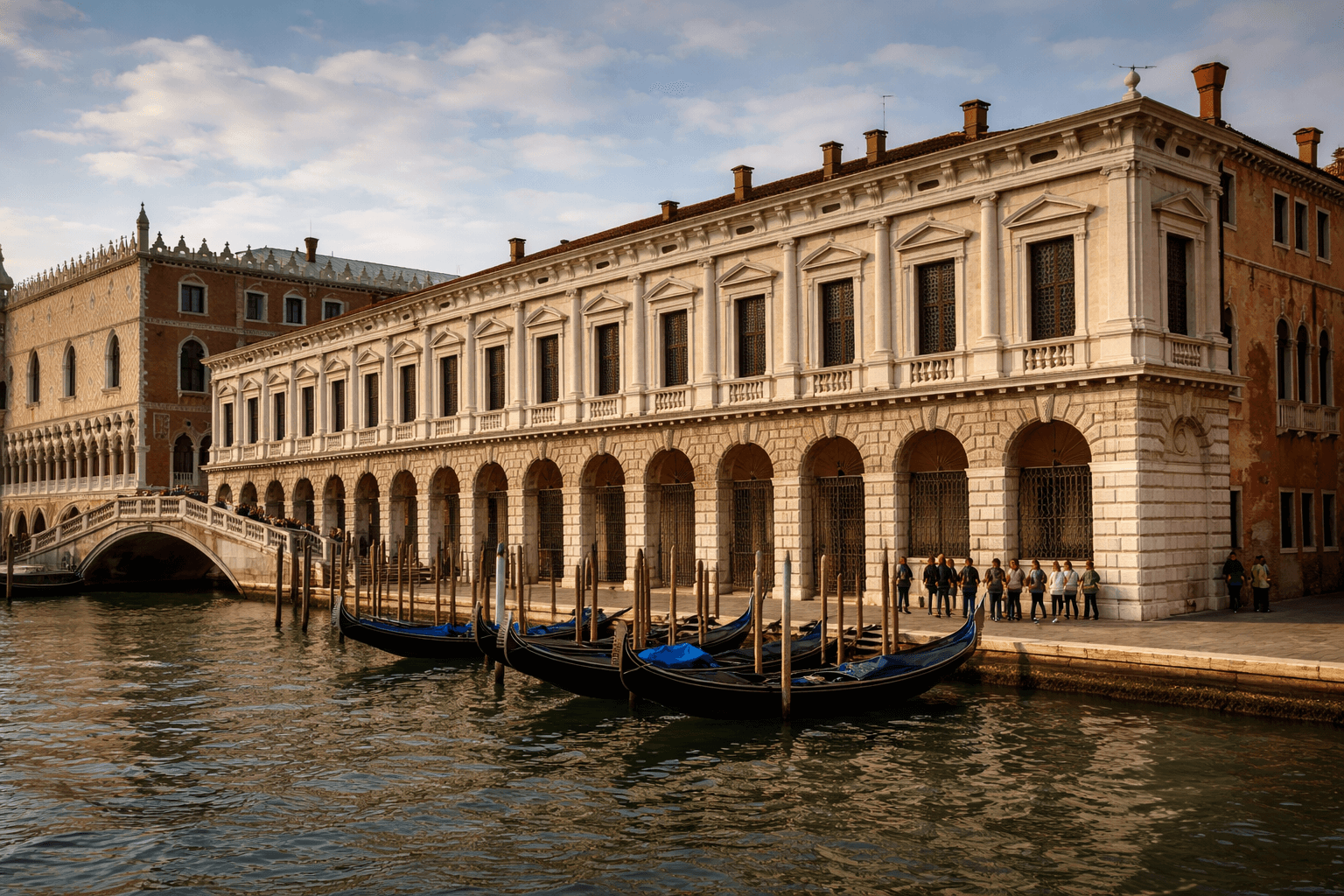
The Palace and the prisons of the Lords of the Night were established as the operational center of one of the most feared magistracies of the Republic of Venice, tasked with ensuring public safety and nocturnal order. The Lords of the Night were responsible for investigations, arrests, and controls, because the city, especially after sunset, became a complex place to govern. Due to the population density, the urban structure made of narrow streets (calli) and hidden squares (campi), Venice required a capillary, but also discreet, control system. The palace was therefore not just an administrative seat, but a true strategic center of Venetian judicial power. In this context, the prisons did not have a symbolic function, but an extremely practical one: to detain, interrogate, and judge. In summary, the complex tells of an organized, structured justice system deeply integrated into urban life, because security was considered a political and social priority.
Architectural structure of the palace
The architecture of the Palace and the prisons of the Lords of the Night perfectly reflects the function for which it was built, because it was not born as a monumental building, but as an operational space. The rooms are essential, functional, and devoid of lavish decorations, yet they transmit a strong sense of authority. Due to the need to separate administrative areas from detention areas, the structure is organized in a hierarchical and rational way. Internal paths are designed for the control of movement, while the transition spaces create a constant sensation of surveillance. It is therefore not a celebratory palace, but a place of practical power. In summary, every architectural element responds to a precise function, because the goal was not to impress, but to govern, control, and administer justice effectively.
The prisons: spaces, cells, and detention conditions
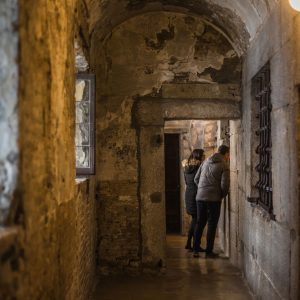
The prisons of the complex represent one of the strongest aspects from an emotional point of view, because they tell the harshest dimension of Venetian justice. The cells are small, bare, and poorly lit, due to the punitive conception of detention. The idea of rehabilitation did not exist, but rather that of custody and containment. The materials used, the bars, the narrow passages, and the massive doors still transmit a sense of physical and psychological oppression today. The tour route allows for an understanding of how prisoners were managed and what the real living conditions were inside the jails. In summary, the prisons are not just historical spaces, but true material documents of a judicial system that reflected the mentality of the time.
Venice: Guided Tour of the Palace and Prisons of the Lords of the Night
The historical role in the Venice of the Serenissima
The Palace and the prisons of the Lords of the Night do not represent just a building, but a fundamental piece of the Venetian political machine. This place demonstrates how the Serenissima was an extremely organized State, because social control was considered essential for stability. Due to international trade, the presence of foreigners, and strong social mobility, Venice had to guarantee constant security, but also discretion. The Lords of the Night acted like a modern police force ante litteram, with clear competencies and defined powers. In summary, the complex tells of a city that was not only art and beauty, but also discipline, rules, and institutional control.
Information on the visit and access to the experience
The visit to the Palace and the prisons of the Lords of the Night is organized as a guided and structured experience, because it allows for a deep understanding of the historical and social context of the place. The route is designed to accompany the visitor progressively, but without overloading with information. Due to the particularity of the environments, the experience is immersive and engaging, suitable for both cultural tourists and curious visitors. In summary, access to the path allows one to experience a different, more authentic, and less conventional Venice.
Cultural and tourist value today
Today, the Palace and the prisons of the Lords of the Night represent a unique cultural experience for visitors, because they offer a different perspective compared to the great Venetian monuments. Due to its lesser notoriety, the visit is more authentic and less crowded, yet extremely engaging. The route allows for an understanding of the less romantic side of the city, the one linked to justice, repression, and the organization of the State. In summary, it is an experience that enriches the knowledge of Venice and makes it more complete, because it also shows its shadows, not just its lights.
Venice: Guided Tour of the Palace and Prisons of the Lords of the Night
FAQ – Palace and the prisons of the Lords of the Night
- What is the Palace and the prisons of the Lords of the Night?
It is a historical Venetian complex that housed the magistracy in charge of public order and the related detention facilities. - Why is it an important place in the history of Venice?
Because it represents the control and justice system of the Serenissima, showing how state power functioned in daily life. - Is the visit suitable for tourists?
Yes, because the route is structured in a clear and accessible way, yet offers deep and authentic cultural content. - How long does the visit last on average?
The duration allows for a complete experience without being excessively long, making it easy to integrate the visit into the daily schedule. - Is it a suitable visit even for those who already know Venice?
Yes, because it shows a lesser-known and more historical Venice, offering a new and complementary perspective to the classic routes. - What makes this experience different from other Venetian attractions?
The fact that it tells the judicial and institutional side of the city, because it does not focus on art and monuments, but on the structure of power and justice.