

How to get to Venice by car: practical tips, parking and tourist advice
- 7 min read
Arriving in Venice by car is an experience that interests many tourists because it allows them to face the journey with total freedom, but it requires some special attention that is not encountered in other Italian cities. Due to its entirely pedestrian structure, Venice imposes a very clear limit on road vehicles, and knowing these aspects in advance makes everything simpler. In short, it is the organization that determines whether the arrival in Venice will be smooth or stressful, because parking, connections, and timing play a fundamental role and affect the comfort of the entire visit.
Venice City Pass all Inclusive 72h
Getting to Venice by Car and Understanding Access to the City
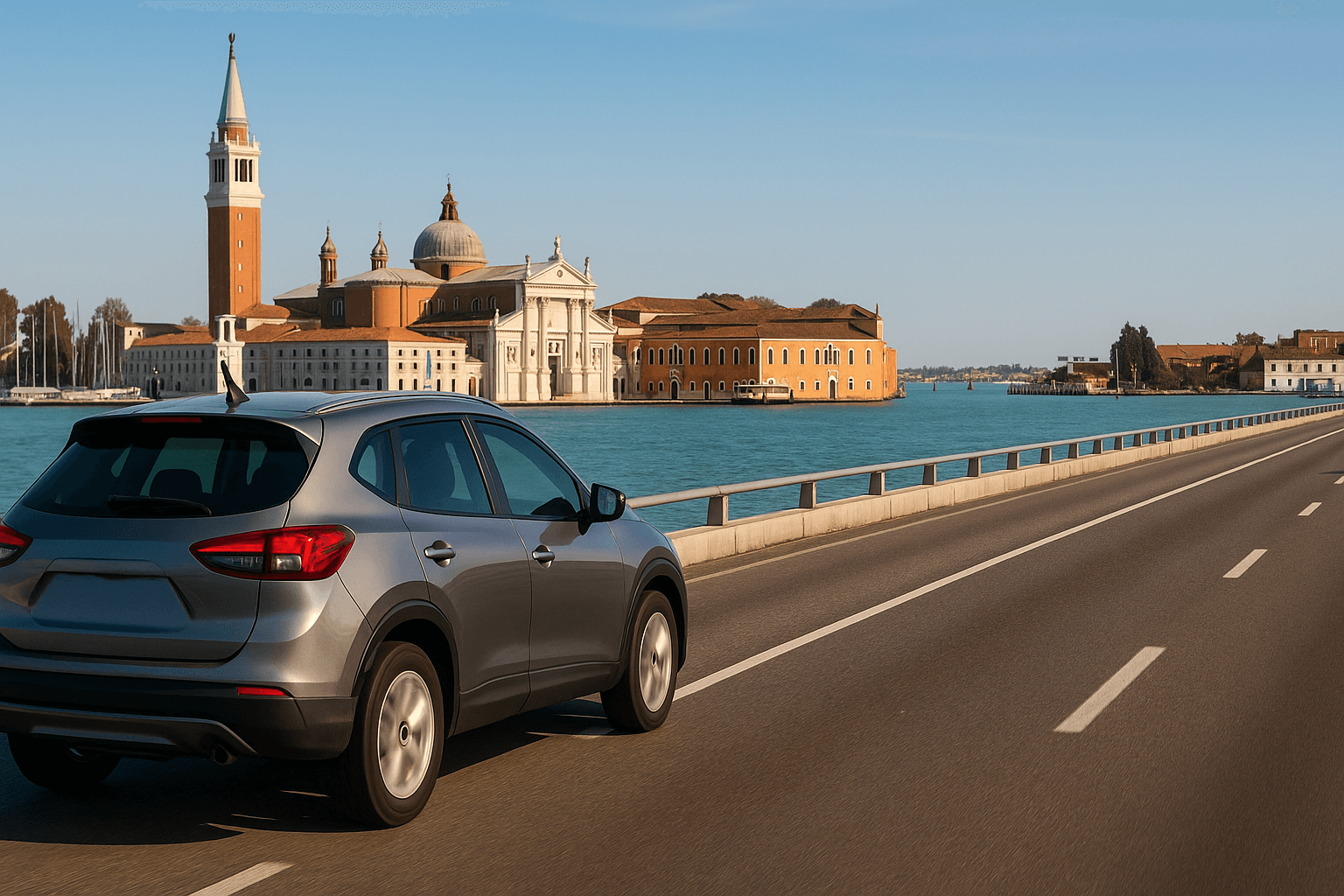
Reaching Venice by car means approaching a unique city, where streets, bridges, and canals coexist in a rare balance. This entails a peculiarity: the car cannot enter the historic center because there are no passable roads. Therefore, the route always ends at Piazzale Roma or Tronchetto, the two areas equipped to accommodate thousands of vehicles every day. Many travelers arrive expecting to find abundant parking but soon discover that availability is limited due to the very high number of visitors and the high costs that characterize the area. In short, as soon as you take the Ponte della Libertà, it becomes clear that you need to know where you are going already.
The final part of the journey is very intuitive because it is well-signposted: following the “Venezia” signs you reach the bridge and, once across, you are automatically guided towards Piazzale Roma or Tronchetto. However, especially during high season, traffic can slow down abruptly due to queues that form as early as the first hours of the morning. For this reason, knowing the available alternatives allows you to avoid unnecessary waits and better manage your arrival times.
Where to Park in Venice: Piazzale Roma and Tronchetto
Piazzale Roma is the point where everyone must stop when they arrive in Venice by car, as it is the last area reachable by vehicles. It is a strategic location because it is literally right next to the first pedestrian bridges of the center, but it is also one of the most expensive and crowded car parks in Italy due to its position. The municipal garage, with over 2000 parking spaces, is the largest structure and slightly cheaper than private garages, but it is almost always fully booked. In summary, you only park here if you book well in advance.
A short distance away is Tronchetto, an artificial island entirely dedicated to parking. It is larger, airier, and slightly cheaper than Piazzale Roma because it is a few minutes further from the center. Many tourists choose this solution for a practical reason: the availability of spaces is higher and, even on the busiest days, it is rare not to find space. Due to this greater flexibility, Tronchetto is perceived as the best choice for those who want to avoid the stress of the final few hundred meters.
Reaching the Center from the Main Car Parks and Organizing Movements
Once the car is left, the most common question is: “And now how do I get to the heart of Venice?”. From Piazzale Roma, the route is simple because in just five minutes on foot you reach the Venezia Santa Lucia station by crossing the Ponte di Calatrava, a modern attraction that connects two fundamental points of the city. From here, the main tourist routes branch out leading towards Rialto, San Marco, and all the most visited areas.
From Tronchetto, however, the People Mover is the fastest means of transport as it connects the car park to Piazzale Roma in just four minutes. It is a convenient solution because it allows you to avoid traffic and quickly reach the starting point for the vaporetti (water buses). Alternatively, you can directly take the ACTV lines that depart from Tronchetto and connect both the Lido islands and other areas of the lagoon. In short, the choice of transport depends on the type of luggage, the time, and the tourist route you intend to follow.
Venice City Pass all Inclusive 72h
Parking in Mestre: Why This Solution Can Be More Strategic
Many tourists choose to avoid the bridge entirely and decide not to arrive in Venice by car, but to park it in Mestre, just before the entrance to the lagoon. This option is ideal because it allows you to save significantly on fares and avoid the intense traffic that arises due to the constant flow of cars heading towards Venice. Mestre offers numerous guarded car parks near the train station, such as those in Via Torino, Ca’ Marcello, or San Giuliano, all convenient for leaving the car safely.
From Mestre, the connection to Venice is extremely efficient because buses and trains depart every few minutes. The journey takes 7 to 12 minutes and allows you to arrive directly at Piazzale Roma or Santa Lucia station without stress. In summary, this solution allows you to save time and money, and is particularly appreciated by those visiting the city for multiple days or preferring to avoid high-density tourist areas.
The Fusina and Punta Sabbioni Alternatives for a More Relaxed Arrival
For those who desire a more relaxed arrival, far from queues and traffic jams, Fusina and Punta Sabbioni represent two excellent options. In Fusina, there is a large and shaded car park, very easy to reach from the motorway because it is well-signposted. It is a less considered choice, but it allows you to save money and experience a suggestive journey thanks to the boats that connect the terminal to the Zattere, in the heart of the city, at least once an hour. Due to the lower frequency of connections, it requires good planning, but it rewards with splendid views of the lagoon.
Punta Sabbioni, on the other hand, is the perfect option for those staying in the seaside areas of Cavallino or Jesolo. The car parks are cheaper, and the vaporetti (water buses) depart frequently towards San Marco, Murano, Burano, and Torcello. In summary, it is the ideal starting point for those who want to reach the center by water, completely avoiding road traffic.
How to Get to Venice by Car from the Main Motorways
Reaching Venice by car is simple because the city is located at a fundamental road junction in Northern Italy. The A4 connects Turin to Trieste passing through Milan and Verona, while the A27 descends from Belluno and allows a direct connection from the north-east. Once off the motorway, the signs automatically guide you towards Mestre or the Ponte della Libertà.
Those heading to Fusina must instead exit at Mestre-Via della Libertà and follow the signs “Parking + Boat to Venice”. Those preferring Punta Sabbioni must head towards Jesolo following the deviation indicated after the airport. In summary, road access is intuitive, and the choice depends solely on the area where you intend to park.
Venice City Pass all Inclusive 72h
FAQ – How to Get to Venice by Car
1. Is it difficult to reach Venice by car?
No, because the signs are clear; however, it is necessary to know where to park due to limited spaces.
2. Is it mandatory to book a parking spot?
It is not mandatory, but it is highly recommended for Piazzale Roma and Tronchetto.
3. How much does parking in Venice cost?
Central car parks are expensive due to the strategic location; Mestre and Fusina offer economic alternatives.
4. Is it better to leave the car in Mestre?
Yes, if you want to save money while avoiding traffic; in short, it is a very practical choice.
5. Do Fusina and Punta Sabbioni take you directly to the center?
Yes, because the boats take you towards San Marco or the Zattere.
6. Is the car needed to visit Venice?
No, because the center is completely pedestrian.