

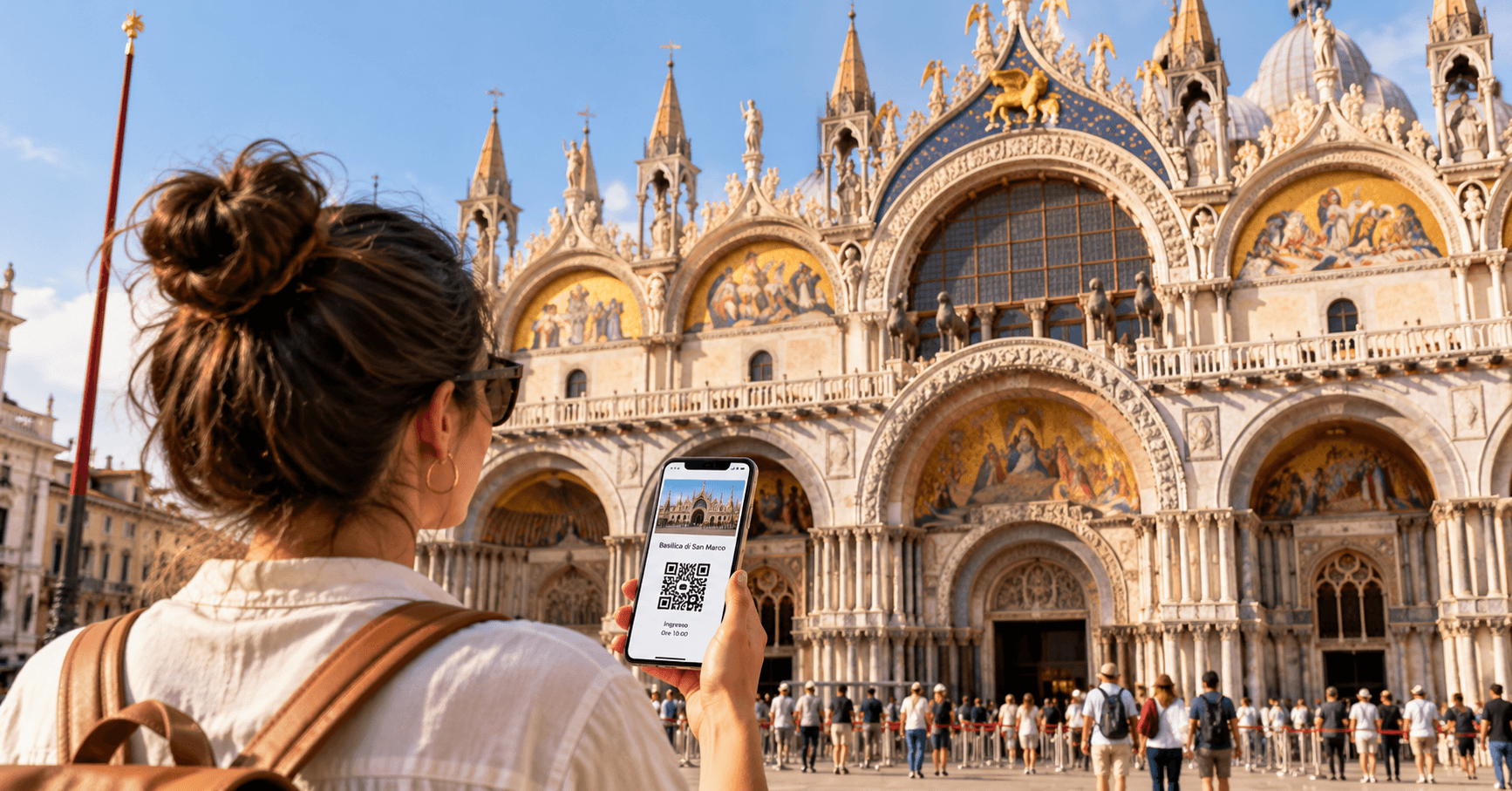
A basilica to be read: why the visit takes method
To understand why St Mark’s Basilica is so different from an ordinary church, you have to start from its origins. The relics of the Evangelist Mark, brought to Venice from Alexandria in Egypt in 829 by Venetian merchants, made the city the custodian of an apostolic saint and gave it a religious identity independent of Rome and Constantinople. The present building took shape from the 11th century onwards, modelled on the Church of the Holy Apostles in Constantinople, with its characteristic Greek-cross plan crowned by five domes. Until 1807 it remained the doge’s palatine chapel; only in that year did it become the cathedral of Venice.
This history translates into a layered building in which every era has left its mark: the mosaics are spread across several centuries, the marble-inlay floor undulates because of the settling of the lagoon ground, and the spoils of Constantinople after 1204 enriched the Treasury and the façade. It is a place that can be crossed in half an hour or studied for an entire morning, and the difference depends almost entirely on how access is organised.
How access works: free area and paid areas
The first thing to clarify is the division of the experience into several levels. Access to the main part of the basilica, the naves, follows a different regime from the sections of greatest artistic value: the Pala d’Oro, the Treasury and the St Mark’s Museum with the Loggia dei Cavalli require a dedicated ticket. The entry and booking rules for the nave are updated over time by the Procuratoria di San Marco, the body that manages the monument, so it is wise to check them before your chosen date.
The practical point is that the real visiting experience is concentrated precisely in the paid areas. It is there that you can observe up close the enamel and gems of the Pala d’Oro, the Byzantine reliquaries of the Treasury and the four gilded bronze horses, and from there you look down over Piazza San Marco from above. Anyone planning a visit should therefore think not about simple entry, but about the complete route they wish to follow.
Why book Basilica tickets in advance
In the central months of the year and on long weekends, the flow towards the basilica is such that entries are regulated and capped. Turning up without a booking means exposing yourself to very long waits outdoors, under the summer sun or in the middle of the crowd in the square, or risking not finding a place in the desired time slot. Booking online as soon as your travel dates are confirmed, on the other hand, allows you to choose a precise time, to enter through the lane reserved for those who already have their ticket, and to build the rest of your day around a fixed appointment.
There is also a less obvious advantage: booking forces you to plan. In San Marco, within a few minutes’ walk, you find the Basilica, the Doge’s Palace, the Campanile, the Correr Museum and the Biblioteca Marciana. Deciding in advance in which order to visit them, and with which option, avoids the typical day in which you spend more time in queues than inside the monuments.
A full overview of what the square offers is in What to see in Piazza San Marco: attractions, museums and travel tips.
Which visit options you can choose
The available solutions can be grouped into three approaches, designed for different visiting needs. The first is the visit with quick entry and a self-guided route, suited to those who already know the history of the basilica or prefer to proceed at their own pace with a personal audio guide. The second is the guided tour, in which a professional accompanies the group along a carefully planned route and conveys the meaning of what you are looking at. The third is the combined option, which links the basilica with the Doge’s Palace and other museums of the square, or with a gondola experience.
The difference between the first two is not only economic but interpretive. The mosaics of San Marco are an enormous story told in images: scenes from Genesis, stories of Christ and the apostles, the life of the Evangelist and the translation of his relics, with a symbolic hierarchy that changes from dome to dome. Without a key to read them, visitors perceive above all the richness of the gold; with a guide, they recognise subjects, patrons and political meanings. For those who visit San Marco only once in their lifetime, it is the difference between seeing and understanding.
Guided Tour of St Mark’s Basilica and the Historical Gallery
The guided tour that combines the Basilica and the Historical Gallery is the most suitable solution for those who want to focus the visit on the building and its story. The route is led by an expert guide, who alternates reading the mosaics, observing the Byzantine architecture and exploring the history of the relationship between the Serenissima and its patron saint. It is the option best suited to those travelling out of cultural interest, to those accompanying curious guests, and to those who, being on their first visit to Venice, want a solid foundation on which to build the rest of their stay.
Guided Tour of St Mark’s Basilica and St Mark’s Historical Gallery
From €42.00 · Discover
Basilica, Doge’s Palace and the museums of Piazza San Marco in a single visit
The Basilica and the Doge’s Palace are the two poles of Venetian power: one religious, the other political, facing the same square and historically linked by the figure of the doge. Visiting them in sequence, on the same itinerary, lets you grasp what neither tells on its own. At the Doge’s Palace you pass through the great rooms of government, the Great Council Hall, the Bridge of Sighs and the old prisons; in the basilica you see where power turned to the divine. The options that combine them are therefore the most coherent choice for those who have a day, or a long morning, to devote to the historic heart of Venice.
The guided tour that includes the Basilica, the Doge’s Palace and the museums of the square is the broadest version of this approach: a guide accompanies the visitor through the main monuments, optimising access times and restoring the thread that links them. Some options also include the museums that complete the museum system of the square, among them the Correr Museum, the National Archaeological Museum and the Biblioteca Marciana.
Those who wish to compare the different integrated-access solutions can consult St Mark’s Pass: how it works, which attractions are included and why choose it.
Guided Tour of St Mark’s Basilica + Doge’s Palace + Piazza San Marco Museums
From €133.00 (was €139.00) · Discover
With the family: Basilica, Doge’s Palace and gondola
Visiting monuments of this complexity with children or teenagers is possible, provided you alternate moments of attention with moments of lightness. For this reason there is an option designed for families, which adds a gondola ride along the canals to entry to the two main monuments of the square. The logic is simple and effective: the cultural part remains dense but contained, and the gondola ride offers a moment of pause that turns the day into a shared memory, not a succession of rooms to get through.
Venice Family Pass: Gondola + St Mark’s Basilica + Doge’s Palace
From €138.00 (was €149.00) · Discover
What to see inside: mosaics, the Pala d’Oro and the Treasury
On entering, the impression is of being inside a gigantic reliquary. The mosaics cover domes, vaults and lunettes with scenes from the Old and New Testaments, produced over several centuries by Byzantine and Venetian craftsmen. Among the domes, the most famous is the Dome of the Ascension, at the centre of the basilica; beside it are the Dome of Pentecost, above the main nave, and the Dome of Emmanuel, above the presbytery. The floor, with its inlays of polychrome marble and geometric and animal motifs, is itself a work of art to be observed carefully, also for its characteristic undulating surface.
The most precious point of the route remains the Pala d’Oro, the great altarpiece placed behind the high altar. It is the result of a long layering, between Byzantine goldsmithing and later interventions, which has its roots in the 10th century and took on its present Gothic form in 1345. Enamels, gold and precious stones make up an iconographic apparatus that for centuries was shown only on the most solemn liturgical occasions. The Treasury, in turn, preserves chalices, reliquaries and liturgical objects largely coming from Constantinople, which reached Venice after the sack of 1204 during the Fourth Crusade. A dedicated ticket is required for these two areas, and this is one of the reasons why choosing the right option affects the entire visit.
St Mark’s Museum and the Loggia dei Cavalli
Going up to the St Mark’s Museum you reach the Loggia dei Cavalli, the terrace that opens above the main portal and overlooks Piazza San Marco. From here you see the square from above, in a perspective found nowhere else, and you meet the four gilded bronze horses, a symbol of Venice. The originals, which arrived from Constantinople in 1204, are now kept indoors for conservation reasons, while the copies can be admired on the façade. Their story is a tale in itself: in 1797 Napoleon had them transferred to Paris, and they returned to Venice in 1815.
The Campanile: the complementary visit for seeing San Marco from above
Those who want an even wider vantage point will find in the St Mark’s Campanile the ideal completion of the visit. Almost a hundred metres tall, it offers a 360-degree view over the square, the lagoon and the rooftops of the city. The bell tower you see today is a reconstruction: it collapsed on 14 July 1902 and was faithfully rebuilt “as it was and where it was”, inaugurated in 1912. Visiting it together with the basilica lets you read the same space from two complementary perspectives, the inner, secluded one of the mosaics and the outer, open one of the panorama.
To learn more: Why it is worth visiting St Mark’s Campanile: history, tips and panoramic views
Tickets for the Campanile and the Historical Gallery of Piazza San Marco
From €38.00 (was €48.00) · Discover
How to dress and behave: the rules of the Basilica
St Mark’s Basilica is an active place of worship and applies a dress code that is carefully enforced at the entrance. Shoulders and knees must be covered and head coverings must be removed. Those wearing low-cut tops or shorts can bring a light scarf or shawl to use as a cover-up, to avoid being refused entry after waiting in the queue.
Inside, the use of flash is forbidden, so as not to damage the gold tesserae of the mosaics over time, and quiet, respectful behaviour must be maintained. Large backpacks and bags are not allowed: a deposit service is available nearby, but it is best to travel light and check the up-to-date conditions.
Need a complete summary with practical examples of what to wear? How to dress to enter St Mark’s Basilica: rules, tips and what to wear
How to get there and how to organise the day of your visit
The basilica is located in the square of the same name, reachable on foot from almost anywhere in the historic centre or by the vaporetto lines that stop at San Zaccaria or San Marco-Vallaresso, a few minutes from the entrance. The advice is to arrive in the square fifteen to twenty minutes before your booked time, to calmly find the lane reserved for those who already have their ticket and avoid getting mixed up with the queue of those buying on the spot.
Carrying your ticket in digital format, together with an ID document, lets you get through the checks without a hitch. If you are also visiting the Doge’s Palace on the same day, it is best to alternate the basilica, which has a more compact route, with the halls of the Doge’s Palace, choosing the sequence according to your booked times. For details on walking routes, vaporetto lines and arrival by gondola, the reference guide is How to get to St Mark’s Basilica in Venice.
FAQ – St Mark’s Basilica Tickets
1. Is it necessary to book St Mark’s Basilica tickets in advance?
In high season, booking in advance is strongly recommended: places for each time slot sell out days ahead, and those who turn up without a ticket risk very long queues or not being able to enter at the desired time.
2. What is the difference between a skip-the-line entry and a guided tour?
Quick entry guarantees access without waiting while leaving the visit self-guided; the guided tour adds a guide who explains the history, symbols and meaning of the mosaics and spaces, and is the best choice for a first visit.
3. What does the option with the Doge’s Palace and the museums of Piazza San Marco include?
It combines the visit to the Basilica with the Doge’s Palace, including the Bridge of Sighs and the prisons, and in some options also the museums of the square such as the Correr Museum, the National Archaeological Museum and the Biblioteca Marciana.
4. How long does the visit to the Basilica take?
A self-guided visit can take about half an hour; including the Pala d’Oro, the Treasury and the Museum with the Loggia dei Cavalli, or choosing a guided tour, the time needed extends to over an hour.
5. What is the best time of day to avoid the crowds?
Opening time in the morning and late afternoon are the quietest periods; the latter also offers a light that brings out the golden mosaics. Between late morning and early afternoon, crowds are at their peak.
6. How should I dress to enter the basilica?
You need shoulders and knees covered and no head coverings. As it is an active place of worship, the code is enforced at the entrance and may result in being refused access.
7. Can I enter with a backpack or luggage?
Large backpacks and bags are not allowed. A deposit service is available nearby, but it is preferable to travel with a small backpack and check the up-to-date conditions.
8. Is it worth visiting the Campanile on the same day as the Basilica?
Yes: they are complementary, because the basilica is seen from the inside and the Campanile offers the view from above over the square and the lagoon. Organising them on the same morning optimises your movements.