

How to reach Murano from Venice: routes, ACTV lines and useful suggestions
- 8 min read
Visiting Murano is one of those choices that almost always “comes in handy,” because the island is close, easy to get around, and offers a different experience from the more crowded Venice. However, due to the number of lines and stops, it often happens that people waste time or board the wrong water bus. This guide explains how to reach Murano from Venice in a practical way, with a style suitable for tourists and easy-to-follow directions. Furthermore, it highlights the most convenient solution for moving around without worries: Vaporetto ACTV Venice, ideal because it allows using public transport with greater freedom, but especially when multiple trips are planned in a day. In summary, good planning makes the difference between a relaxing crossing and a morning of running around in vain.
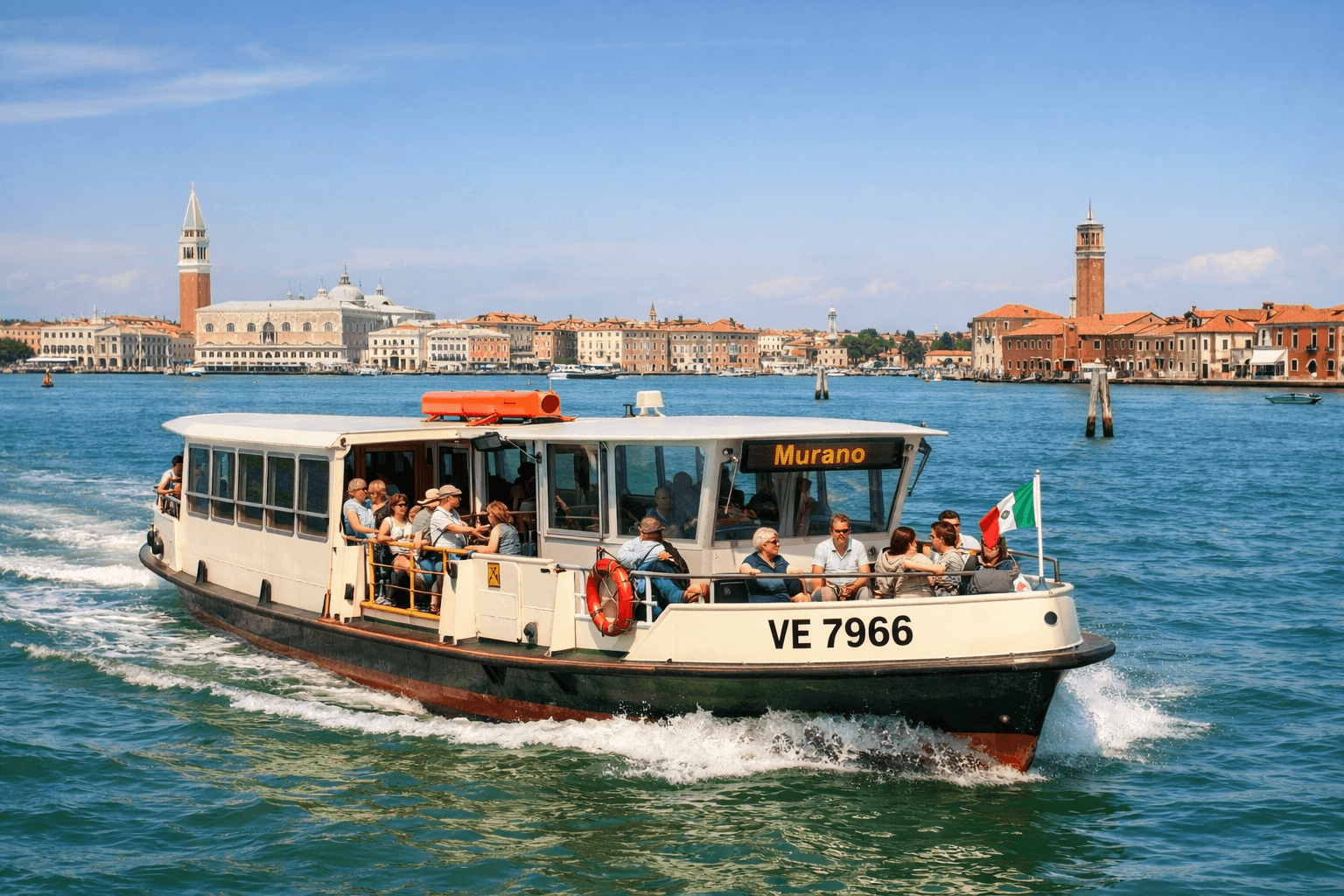
Venice: ACTV Daily Vaporetto Pass
How to reach Murano from Venice
To get to Murano, the general rule is simple: water is used, because the island is not connected by road bridges. In summary, the main options are:
- Vaporetto ACTV (public transport): the most used solution because it is regular and widespread.
- Water taxi: faster, but much more expensive due to private pricing.
- Organized tours: convenient because they include stops and schedules, but less flexible. In most cases, how to reach Murano from Venice means choosing the vaporetto: it is intuitive, frequent, and allows you to manage the day well even if you decide to return early.
Vaporetto ACTV: simplest option to reach Murano
The vaporetto is the preferred option for tourists because you depart from different areas of Venice and arrive directly at the Murano stops. However, due to water traffic and attendance, it is advisable to leave with a minimum of notice. In summary, with ACTV you “enter” Venetian life without complications.
Most used ACTV lines for Murano
Lines can change based on the season and schedules, but the most common for Murano are:
- Line 3: often fast and direct on some stretches, because it is designed for main connections.
- Lines 4.1 and 4.2: useful because they do a wide “loop” and connect multiple points.
- Line 12: much used because it connects Fondamente Nove towards Murano and then often continues (useful if you extend the visit). Practical note: lines and frequencies can vary, but the logic remains: choose the closest departure stop and the most direct line due to limited travel time.
Convenient stops in Venice to depart from
For those visiting Venice, the most convenient departures are:
- Piazzale Roma: practical because it is the arrival point for buses and taxis.
- Ferrovia (Santa Lucia Station): convenient because you get off the train and are already on the canal.
- San Marco / Rialto: useful because they are central tourist areas, but often crowded due to main flows.
- Fondamente Nove: strategic because it is a “hub” towards the islands. In summary, to understand how to reach Murano from Venice, you start from where you sleep or arrive, but you choose the most logical stop to avoid unnecessary changes.
Main stops in Murano
Murano has multiple stops and it is convenient to choose the one closest to what you want to see, because that way you walk less. The most common are:
- Murano Colonna
- Murano Faro
- Murano Museo In summary, if the goal is the heart of the island and a simple walk, a central stop is often the best, but if you want a quieter point, you get off slightly outside and return on foot.
Tickets and passes: how to save with Vaporetto ACTV Venice
Many tourists focus only on the “cost of the ride,” but due to the many typical movements (hotel → attractions → return → islands), the real savings often lie in the pass. In summary, the more rides you take, the more a solution that includes unlimited or extended use of ACTV transport is worth it. A pass is often convenient because:
- you avoid buying tickets every time, but especially when there are queues;
- you get on and off freely, due to greater flexibility;
- you can decide at the last minute to add a stop (for example another sestiere or a panoramic point), because you don’t “pay twice” for the choice. In summary, if you are planning how to reach Murano from Venice and then also want to go around Venice on the same day, a pass becomes a logical choice.
Venice: ACTV Daily Vaporetto Pass
How to get to Murano from the most common areas of Venice
Understanding how to reach Murano from Venice often depends on where you are, because Venice is made of different access points.
From Santa Lucia Station and Piazzale Roma
This is a typical departure because many arrive by train or bus. In summary:
- you reach a stop near the station;
- you choose a line that leads towards the Murano stops, but checking the direction carefully;
- you avoid a superfluous change, due to the time lost in the transition.
From San Marco / Rialto
You depart from a scenic area because it is very popular. Due to the crowding, it is advisable to:
- arrive a few minutes early;
- let an overcrowded vaporetto pass, because the next ride might be more comfortable;
- keep an eye on the Murano stops to get off at the right point. In summary, departing from here is easy, but a minimum of patience is needed.
From Mestre
From Mestre, you pass through Venice first because Mestre is on the mainland. In summary, the typical flow is:
- arrival in Venice (train or bus);
- movement towards a convenient stop;
- vaporetto towards Murano. Due to transfer times, it is advisable to leave early, because that way the day remains full and you don’t rush.
Frequent errors and how to avoid them
The most common errors happen because Venice “seems simple” and then reveals itself as a labyrinth of water. In summary, here is what to avoid:
- Boarding without checking the direction: due to circular lines, you can lengthen the trip significantly.
- Getting off at the wrong stop: Murano has multiple stops, but not all are ideal for every itinerary.
- Leaving late: because the return can be more crowded, due to rush hour.
- Buying tickets at the last minute: because queues steal time; in summary, a pass reduces friction.
Practical tips for tourists
- Best time: early morning because you avoid the crowd.
- Families: choose less chaotic stops, because strollers suffer due to the crowds.
- Weather: wind and rain do not block everything, but they make waiting more uncomfortable due to exposure.
- Accessibility: many areas are manageable, but it is better to maintain a margin of time due to ramps and flows.
- Pass strategy: useful because it allows multiple rides and changes without stress, but especially if you move around a lot. In summary, the visit improves when you consider transport as part of the experience.
Venice: ACTV Daily Vaporetto Pass
FAQ on how to reach Murano from Venice
1. How much does the ferry from Venice to Murano cost?
It depends on the type of ticket, because the cost changes between a single ride and a pass. In summary, if more than one trip is planned, the Vaporetto ACTV Venice may be more convenient due to repeated use of transport.
2. Where do you take the ferry to Murano from Venice?
You take it from the main ACTV stops, because many lines connect Venice to the islands. In summary, common points are Ferrovia, Piazzale Roma, San Marco, and especially Fondamente Nove, but the choice depends on where you are.
3. Which public transport stop should I get off at to visit Murano?
The most used stops are Murano Colonna, Murano Faro, and Murano Museo, because each is convenient for different areas. In summary, “Museo” is often central, but “Faro” can be excellent due to its position and the pleasant walk.
4. How do you reach the island of Murano?
It is reached mainly by ACTV vaporetto, because it is the simplest public transport. In summary, it is the standard option when looking for how to reach Murano from Venice without complications.
5. How long does it take to get from Venice to Murano?
The time varies based on the line and stop, because generally the stretch is short. In summary, it is worth considering waiting and crowding as well, due to tourist peaks.
6. Is it better to do Murano in half a day or a full day?
Half a day can be enough because the island is compact, but a full day is more relaxed due to breaks, demonstrations, and photo stops. In summary, the choice depends on the rhythm of the trip.
7. What is the most convenient way to move between Venice and Murano multiple times in the same day?
A pass is often the answer, because it allows freedom of getting on and off. In summary, the Vaporetto ACTV Venice is practical due to flexibility over multiple rides.