

Dorsoduro: the local face of residential and cultural Venice
- 7 min read
Dorsoduro Venice represents one of the most authentic and least artificial expressions of the city, because it preserves a daily dimension that nevertheless coexists with art, culture, and urban beauty. Due to its slightly decentralized location relative to the major tourist flows, this sestiere allows one to experience Venice in a slower, more human, and deeper way. However, it is not a peripheral or isolated area, because it is perfectly integrated into the urban fabric and the cultural routes of the city. For this reason, Dorsoduro Venice becomes an ideal place for those who desire a true experience, not constructed, not filtered, but made of atmospheres, relationships, habits, and daily rhythms. In summary, living in this neighborhood means entering a Venice that is less visible, but more authentic.
Venice City Pass all Inclusive 72h
The deep identity of Dorsoduro
Dorsoduro builds its own identity through a slow and continuous stratification of stories, memories, habits, and social relationships, because it is not a neighborhood that offers itself immediately to the gaze, but an urban space that lets itself be understood over time. Due to its strongly residential nature, daily life here is still visible in a natural way, not staged and not adapted to tourism, but lived as an integral part of the neighborhood’s structure. However, this dimension does not generate closure, because the sestiere remains open, accessible, and welcoming even for those visiting it for the first time. Walking through its calli means crossing a Venice that does not live to be observed, but that continues to live for itself, while offering the visitor the possibility to insert themselves into this urban narrative without forcing it. In this context, the experience is never a spectacle, but a slow immersion into a reality made of continuity, coherence, and everyday life. For this reason, Dorsoduro is not limited to being a place to visit, but becomes a space to understand, to cross, and to internalize. In summary, the neighborhood is not consumed, but lived.
Art, culture and real life in the same urban space
In Dorsoduro, art and culture do not exist as elements separate from daily life, because they are inserted organically within the urban fabric. Due to the presence of cultural institutions, universities, and artistic spaces, the neighborhood is frequented by international visitors, yet this presence does not alter the social structure of the sestiere. However, a fracture between residents and visitors is not created, because coexistence occurs in a fluid and natural way. Museums, historic palaces, churches, and cultural sites coexist with homes, public spaces, places of study, and daily life, creating a complex but harmonious urban ecosystem. In this scenario, culture is not an isolated tourist product, but an integral part of the life of the neighborhood. For this reason, the cultural experience in Dorsoduro is never artificial or sensationalized, but deeply integrated into urban normalcy. In summary, the value of the neighborhood lies in its ability to make culture a lived dimension and not just an observed one.
The fondamenta as places of life and relationship
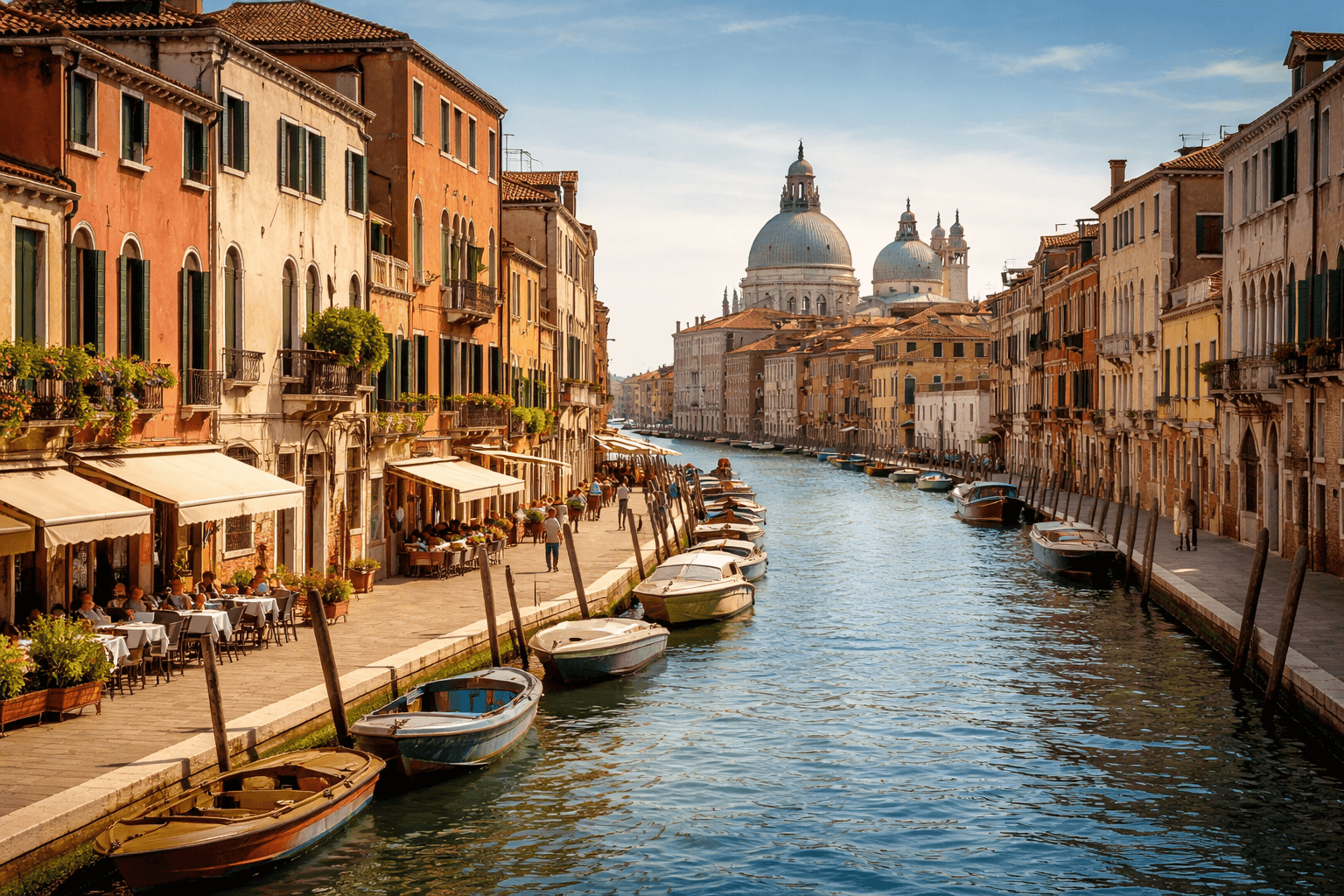
The fondamenta of Dorsoduro Venice represent one of the most identifying components of the sestiere, because they are not simple spaces of passage, but true places of sociality and relationship. Due to their open conformation overlooking the water, they become natural stopping spaces, where time slows down and the urban rhythm becomes more human. However, these are not places built for tourism, because local life continues to flow spontaneously and authentically. Residents, students, and visitors share these spaces without symbolic barriers, creating a daily coexistence that is never forced. In this context, sitting along a fondamenta means entering a living social dimension, made of silences, observation, conversations, waits, and small daily gestures. For this reason, the fondamenta are not simply architectural elements, but true social devices that build urban identity. In summary, the fondamenta of Dorsoduro Venice tell the story of the city through the normalcy of life.
Venice City Pass all Inclusive 72h
Everyday life as an authentic experience
Living Dorsoduro like a local means adopting an approach based on everyday life, because it is in simple gestures that the deepest identity of the neighborhood manifests itself. Due to its compact, walkable, and livable dimension, every movement becomes an integral part of the urban experience, but without stress and without overcrowding. However, this does not generate isolation, because the sestiere remains fully connected to the rest of the city. Crossing the campi, walking the calli, observing social dynamics, entering places frequented by residents allows one to experience a Venice that is less spectacular but more true. In this scenario, the tourist is no longer a simple observer, but becomes a temporary part of urban life, inserting themselves into a system that continues to exist independently of their presence. For this reason, the experience is not the consumption of places, but participation in a real social dimension. In summary, Dorsoduro does not offer isolated attractions, but a different way of living the city.
A model of slow and conscious tourism
Dorsoduro Venice represents a model of slow and conscious tourism, because it favors an approach based on observation, listening, and understanding of places. Due to the lower tourist pressure compared to other areas of the city, the neighborhood allows for a more relaxed enjoyment of urban spaces, but without sacrificing cultural quality. However, this slowness does not imply a poverty of content, because the historical, artistic, and social heritage is extremely rich. The experience thus becomes a continuous narrative path, made of spaces, atmospheres, relationships, and perceptions. For this reason, living Dorsoduro Venice does not mean “visiting” a neighborhood, but crossing a complex and stratified urban ecosystem. In summary, the sestiere configures itself as a laboratory of authentic Venetian experience.
Why Dorsoduro Venice embodies the authentic Venice
Dorsoduro embodies a form of Venice that resists transformation into a tourist product, because it preserves a living, functional, and stable social structure. Due to the constant presence of residents, students, and local activities, the neighborhood maintains a human dimension that is progressively being lost in other areas. However, it is not a marginal or isolated area, because it is fully integrated into the urban, cultural, and economic system of the city. In this balance between real life and tourist attractiveness, its identity strength is built. For this reason, living Dorsoduro like a local means entering a Venice that is truer, more coherent, and deeper. In summary, the value of the sestiere is not only aesthetic, but social, cultural, and human.
Venice City Pass all Inclusive 72h
FAQ – Dorsoduro
- What are the things to see in Dorsoduro? Dorsoduro offers museums, historic churches, cultural spaces, and authentic urban areas, yet the true experience is not linked only to specific places, because the main value is living the daily atmosphere of the neighborhood, observing local life and its rhythms.
- Why is it called Dorsoduro? The name derives from the conformation of the land, because historically the area was characterized by more solid soil compared to other areas of the lagoon. Due to this characteristic, the neighborhood was more stable and more easily habitable over time.
- How can I get from Dorsoduro to St. Mark’s Square? It is possible to arrive on foot by crossing the historic center, but also via direct water connections. Due to the good urban connection of the sestiere, the link is simple, linear, and accessible.
- Is Dorsoduro Venice suitable for tourists? Yes, because it offers an authentic experience, but without sacrificing services, accessibility, and cultural quality. In summary, it represents an ideal choice for conscious and non-superficial tourism.
- How much time is needed to truly live Dorsoduro? It depends on the approach, because a quick visit is possible, but an authentic experience requires time, slowness, observation, and immersion.
- Is Dorsoduro Venice a residential area? Yes, because it is inhabited by historical residents and students, due to the university presence and local services. However, it remains fully usable even for visitors, without losing its identity.