

Bridges in Venice: which to see, why they matter, and the stories they tell
- 6 min read
Venice is a city built on water, and for this urban system to function, the connections between islands play a fundamental role. The Bridges in Venice are not just simple architectural structures, but actual chapters of a history spanning centuries. Each bridge connects not only two banks but also different eras, traditions, trade, and daily lives. Due to the unique shape of the lagoon, Venice has developed an extraordinary number of bridges, each with a practical and symbolic function. In short, to understand the Bridges of Venice is to understand the city itself.
Venice City Pass all Inclusive 72h
The Rialto Bridge: Economic Center and Icon
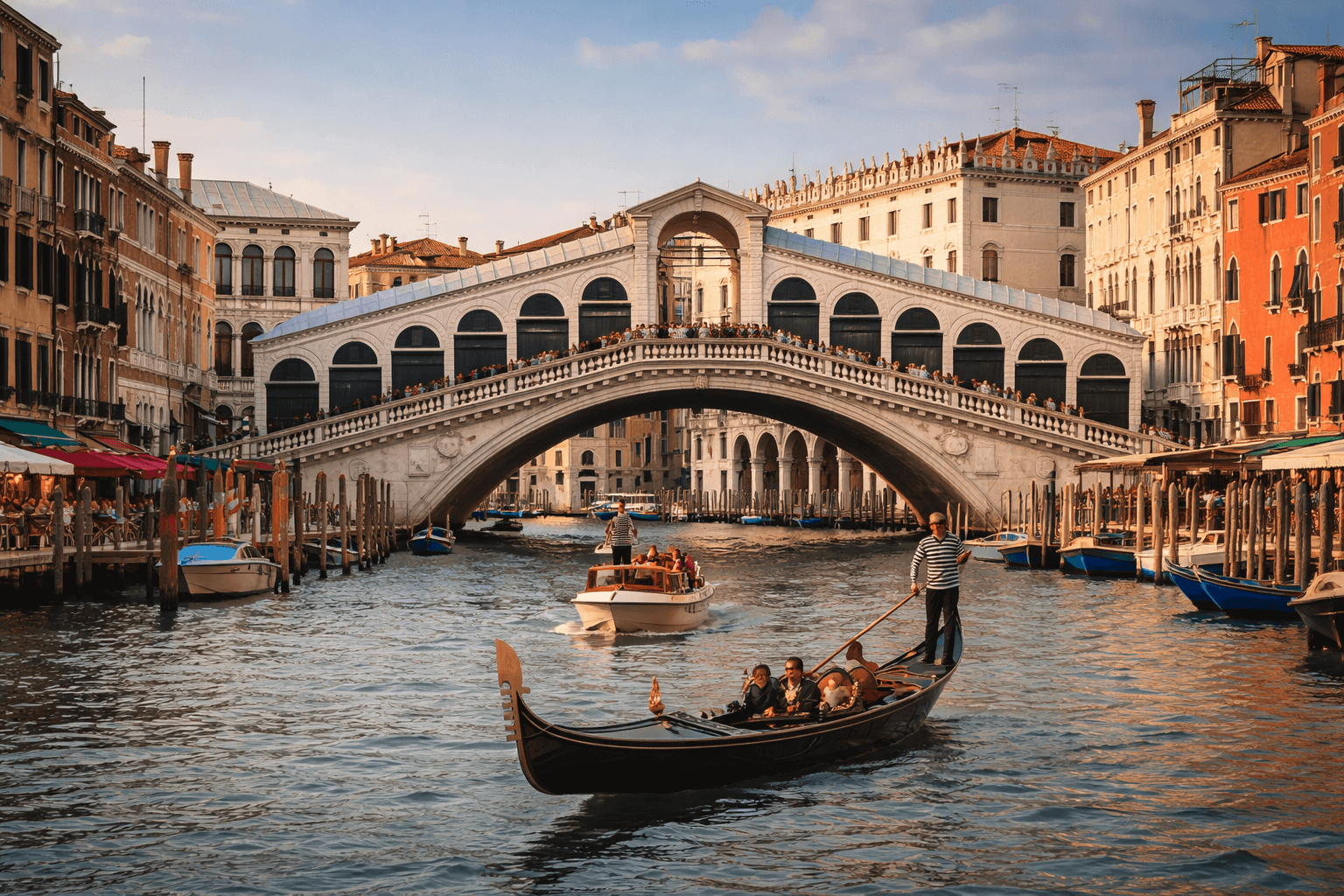
The Rialto Bridge is undoubtedly one of the most famous and photographed bridges in Venice. It is located in the commercial heart of the city, as this area has been the hub of economic exchange since the Middle Ages. The current stone bridge dates back to the late 16th century; however, wooden structures existed before it, which often collapsed due to weight and wear. Because of these issues, it was decided to build a more solid and lasting structure.
From a narrative perspective, the Rialto Bridge tells the story of mercantile Venice. Spices, fabrics, and precious metals passed through here, but also information and political relations. The shops on the bridge are not merely decorative elements, but a testament to the economic function of the site. Crossing the Rialto Bridge means retracing the dynamics that made Venice an international commercial power. For tourists, it represents a privileged vantage point over the Grand Canal and the city’s constant motion.
The Bridge of Sighs: Justice, Power, and Memory
Among the bridges in Venice, the Bridge of Sighs holds a special place in the collective imagination. While often associated with romanticism, its origin is linked to a much harsher history. Built in the 17th century, it connected the Doge’s Palace to the New Prisons. Because of this function, the bridge represented the final passage for prisoners before their detention.
The name derives from the “sighs” of the condemned who, as they crossed the bridge and caught their last glimpse of the lagoon, expressed grief and regret. In summary, this bridge reveals the judicial and repressive face of the Serenissima. Architecturally, the Baroque style and screened windows emphasize the separation between freedom and imprisonment. For the visitor, it offers a different perspective on Venetian history, inviting reflection on the relationship between beauty and suffering.
The Accademia Bridge: Art and Urban Transformation
The Accademia Bridge is one of the most beloved bridges in Venice for the view it offers. It connects the Gallerie dell’Accademia to the Dorsoduro district, an area long associated with artistic and cultural production. The current wooden bridge resulted from a temporary solution that became permanent, and its structure integrates harmoniously into the urban landscape.
Due to its location, the Accademia Bridge is a prime spot for observing the Grand Canal. From here, one can admire historic palaces, churches, and the continuous flow of boats. This bridge tells the story of a Venice in transformation, capable of adapting without losing its identity. For art-loving tourists, crossing it means entering a cultural context of great symbolic value.
Venice City Pass all Inclusive 72h
The Constitution Bridge: Modernity and Debate
Among the most recent bridges in Venice, the Constitution Bridge (Ponte della Costituzione) represents a unique case. Inaugurated in 2008 and designed by a contemporary architect, it connects Piazzale Roma to the Santa Lucia railway station. It has sparked numerous controversies regarding the placement of a modern work within a historic context.
Its structural characteristics have stimulated a broad debate on accessibility and heritage protection. While some consider it a symbol of renewal, others see it as an alien element. Ultimately, the Constitution Bridge tells the story of present-day Venice, grappling with the difficult balance between conservation and innovation. For the visitor, it represents the first contact with the city and a key to understanding its contemporary challenges.
Minor Bridges: Daily Life and Silent Stories
Alongside the famous landmarks exists a dense network of minor bridges that dictate the pace of daily life. Venice is not only made of monumental icons but also of discreet passages often ignored by main tourist flows. These bridges represent essential links between squares (campi), alleys (calli), and quays (fondamenta).
Many of these bridges lack elaborate decorations but tell authentic stories. They were built for practical needs but have taken on an identity value over time. They show an intimate Venice, far from the postcard image. Crossing them means observing the city’s daily rhythm—neighborhood markets, schools, and homes. Every bridge solves a connection problem while simultaneously creating a space for encounter.
Materials and Shapes: Responding to the Lagoon
The bridges of Venice are distinguished by their materials, chosen based on historical and environmental needs. The lagoon imposes harsh conditions, but effective architectural solutions have evolved over centuries. Istrian stone, for example, has been widely used due to its resistance to salt water.
Alongside stone bridges, there are numerous wooden and iron bridges. These materials allowed for faster construction and greater flexibility. The variety of materials reflects the city’s adaptability. For the tourist, observing these shapes means reading the layers of time—from low arches and essential lines to elaborate decorations.
Venice City Pass all Inclusive 72h
FAQ – Bridges in Venice
1. How many bridges are there in Venice?
There are over 400 bridges distributed across the various districts (sestieri) and islands.
2. What are the most important bridges?
The Rialto Bridge (the oldest on the Grand Canal), the Bridge of Sighs, and the Accademia Bridge are considered the most significant.
3. What is the most famous bridge?
The Rialto Bridge.
4. Which is the “Bridge of Lovers”?
Traditionally, the Bridge of Sighs is associated with this legend, though its actual history is related to prisoners.
5. What is the bridge connecting Mestre to Venice?
The Liberty Bridge, a long road and rail infrastructure.