

Create your own glass artwork with a Master and take it home
The cultural significance of the glass Artwork
The glass Artwork assumes a meaning that goes beyond aesthetics, because it encapsulates centuries of history and social transformations. Because of the political and economic choices of the Republic of Venice, glass processing was concentrated on the island of Murano, creating a center of artisanal excellence. Furthermore, this concentration favored the birth of unique techniques and a recognizable style. However, what makes the glass Artwork particularly relevant is the continuity of the tradition, because knowledge is transmitted from generation to generation. Each work therefore becomes a living testimony. In summary, the glass Artwork represents a cultural heritage that continues to tell the Venetian story through the language of fire and glass.
The tourist experience linked to the glass Artwork
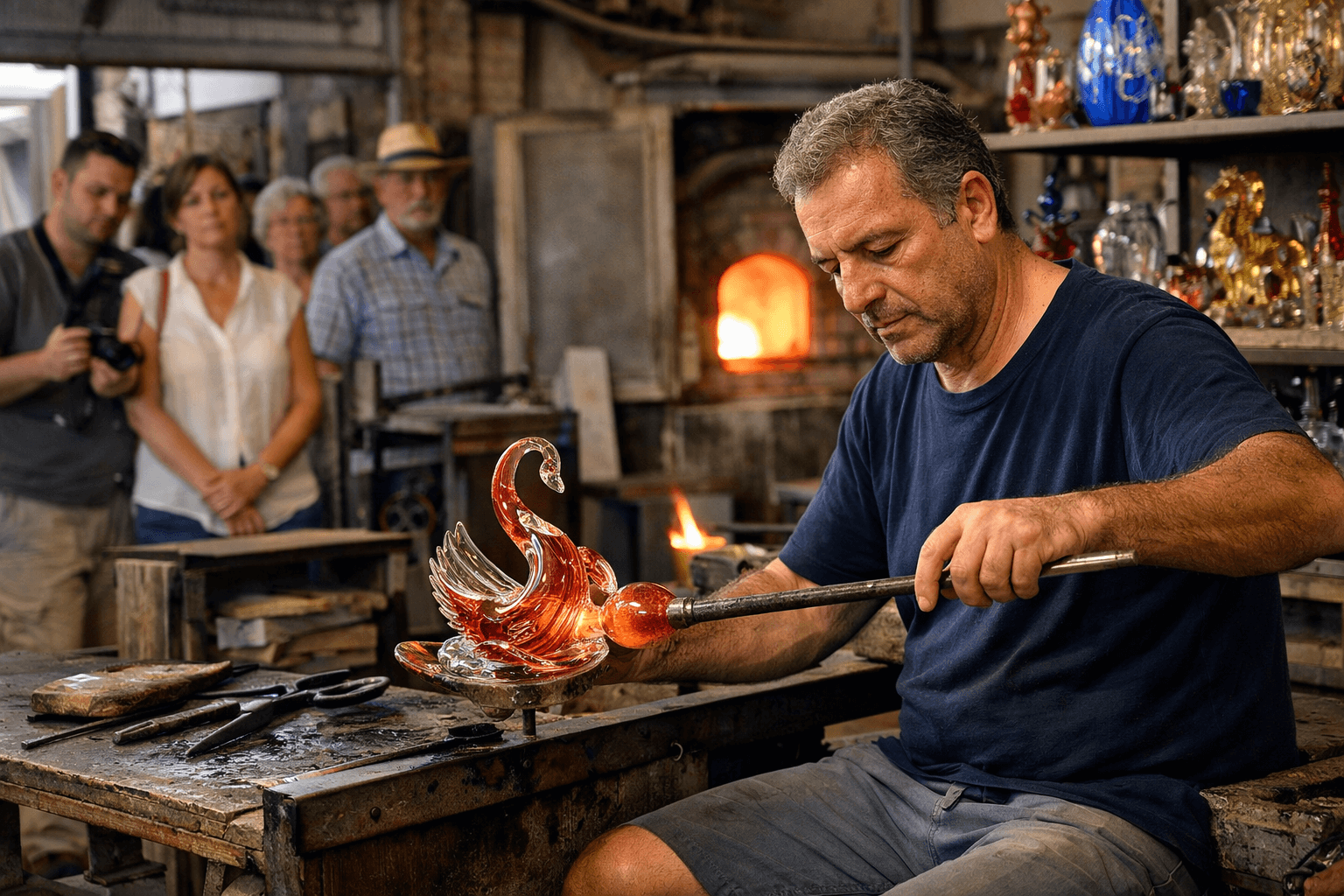
For tourists, the glass Artwork is not only an object to observe, but an experience to live in person. Because of the direct interaction with the master glassmaker, the visitor can understand the value of manual skills and time. Furthermore, witnessing the processing allows one to grasp details that would otherwise remain invisible. However, the most significant aspect lies in the educational dimension of the experience, because every phase is explained with attention. In summary, the glass Artwork becomes a tool of cultural knowledge, capable of enriching the journey and making it more conscious. Precisely for this reason, it is chosen by those who desire a less superficial tourism.
The creative process behind a glass Artwork
The process that leads to the birth of a glass Artwork is complex and requires a competence matured over time. Because of the high temperatures of the furnace, every gesture must be precise and conscious, because the glass remains workable only for a few moments. Furthermore, the speed of execution leaves no room for improvisation, but requires a perfect coordination between mind and hand. However, behind the apparent simplicity of the movements lies a deep knowledge of the material and its reactions. Because molten glass is unpredictable, every glass Artwork is born from a delicate balance between control and adaptation. Furthermore, the master glassmaker must read the material in real time, interpreting its consistency and temperature.
In summary, the creation of a glass Artwork is the result of technique, experience and artistic sensitivity. Precisely for this reason, witnessing the process live allows one to grasp the complexity hidden behind every gesture. Because of this intensity, the experience assumes a strong cultural value. In conclusion, the glass Artwork is not only the final result, but the entire path that leads to its realization.
Create your own glass artwork with a Master and take it home
Glass Artwork and artisanal authenticity
The glass Artwork stands out clearly from industrial products because of its entirely artisanal origin. Every creation is born from manual work that cannot be replicated in an identical way, because the process depends on the direct interaction between artisan and material. Furthermore, small variations in shape or color do not represent defects, but become a distinctive sign of authenticity. However, this difference is not always immediately perceivable by those who observe only the finished product. Because it is precisely during processing that one understands the real value of the glass Artwork.
In summary, authenticity resides in the time, competence and tradition that every piece encapsulates. Furthermore, choosing a glass Artwork means moving away from a logic of standardized consumption. Because of this awareness, the object assumes a symbolic as well as an aesthetic value. Precisely for this reason, the glass Artwork is perceived as a cultural testimony. In conclusion, artisanal authenticity becomes an integral part of the tourist experience.
The value of the glass Artwork in responsible tourism
In the context of contemporary tourism, the glass Artwork assumes an increasingly relevant role from the point of view of cultural responsibility. Because of the direct involvement of local artisans, this experience contributes concretely to the enhancement of the territory. Furthermore, it promotes a slower and more conscious visit model, but also more respectful of traditions. However, the true value emerges because the tourist is not just a spectator, but an active part of the story.
In summary, the glass Artwork becomes a tool of dialogue between those who create and those who observe. Because supporting this type of experience means preserving an ancient knowledge. Furthermore, responsible tourism finds in the glass Artwork a concrete example of balance between economy and culture. Because of this direct interaction, the journey acquires a deeper meaning. Precisely for this reason, the glass Artwork is increasingly appreciated by those looking for authentic experiences. In conclusion, choosing the glass Artwork means making an ethical as well as a cultural choice.
The glass Artwork as a cultural experience for the visitor
The glass Artwork is perceived by the visitor as a complete cultural experience, because it combines observation, listening and understanding. Because of the direct contact with the environment of the furnace, the experience involves the senses in a profound way. Furthermore, the visitor does not limit themselves to looking, but enters into a relationship with a tradition that is still alive. However, what makes the glass Artwork particularly significant is the possibility of understanding the value of the artisanal gesture.
In summary, the experience becomes a story that develops before one’s eyes. Because every phase of processing contributes to building an emotional bond with the place. Furthermore, this type of activity allows for overcoming a superficial vision of tourism. Because of this immersion, the memory of the visit results more lasting. Precisely for this reason, the glass Artwork is chosen by those who wish to know and not just visit. In conclusion, the experience transforms into a moment of authentic and conscious learning.
Create your own glass artwork with a Master and take it home
FAQ – Frequently asked questions about the glass Artwork
- Where can I see glass blowing in Venice?
Glass blowing can be observed mainly in Murano, because the island hosts the historical furnaces and artisanal workshops. - What is Murano famous for?
Murano is famous for its glass Artwork, because of a secular tradition that has made glass art famous all over the world. - How to witness the processing of Murano glass?
It is possible to witness it by participating in demonstrations or lessons, because these activities allow for observing the entire creative process. - What is the difference between common glass and Murano glass?
The difference concerns the technique and the tradition, because Murano glass is made according to historical artisanal methods. - Is the glass Artwork suitable even for those who do not have artistic skills?
Yes, because the experience is designed for a broad audience and is explained in a clear way. - Why is the glass Artwork considered a cultural experience?
Because it combines storytelling, manual skills and tradition, transforming observation into knowledge.